
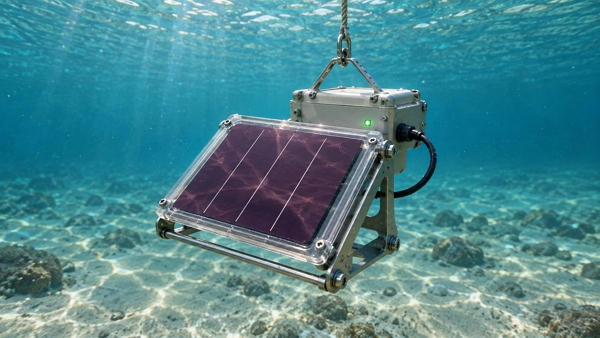
Perovskite solar cells capable of generating electricity even at a depth of 10 metres have been developed. The key was boosting the durability of conventional perovskites, which are vulnerable to moisture, and adjusting absorption characteristics to match wavelengths of light that reach underwater.
According to Ars Technica on Sunday, a research team led by Simin Ma (마) at Yunnan University developed a wide-bandgap perovskite solar cell specialised for underwater power generation and verified its performance in a laboratory and in the South China Sea. The findings were published in the international journal Joule.
Water absorbs a significant portion of sunlight, limiting usable wavelengths as depth increases. The team adjusted the perovskite composition to match light reaching depths of about 10 metres. In tests replicating the light environment at 10 metres underwater, the cell recorded a power conversion efficiency of 34.71 percent. Its certified efficiency under standard solar conditions was 16.79 percent.
To improve durability, the researchers used polyhexamethylene guanidine hydrochloride (PHMG). The additive improved crystal quality and suppressed ion migration and non-radiative recombination, enhancing both efficiency and stability. A module sealed with a protective layer showed almost no performance degradation after about 1,160 hours of testing under underwater conditions. Based on accelerated tests, the T80 lifetime, when efficiency drops to 80 percent of its initial level, was estimated at about 48,094 hours, or 5.49 years. This does not mean use for more than 5 years has been verified in real conditions.
In field tests in the South China Sea, a small module was lowered to depths of 2, 6 and 10 metres to charge a battery. At 10 metres, it produced 324 mWh over 2 hours, allowing a lithium-ion battery to be charged and an LED to be powered. Output at 10 metres was about one quarter of the level at 2 metres, but power fluctuations due to waves decreased at greater depths.
The team expected the technology could eventually be used as a standalone power source for underwater sensors, unmanned submersibles and the marine Internet of Things (IoT). It added that as depth increases, usable sunlight drops sharply, leaving practical operating depth and long-term durability verification as remaining tasks.
 Jae-won Choi
ittt_0801@d-today.co.kr
Jae-won Choi
ittt_0801@d-today.co.kr