
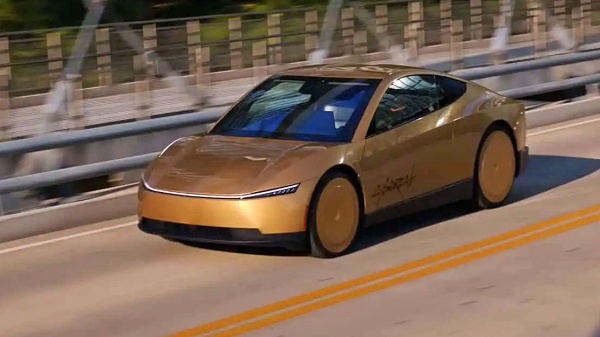
[DigitalToday reporter Jinju Hong (홍진주)] Tesla's robotaxi-only vehicle, the Cybercab, has been confirmed to be designed so it cannot be charged at ordinary homes at present. It removes the onboard charger used in regular electric vehicles, relying instead on DC fast-charging infrastructure such as Tesla Superchargers rather than home AC charging.
On Sept. 11 local time, electric-vehicle outlet InsideEVs reported that the Cybercab does not include an onboard charger used for home charging in regular EVs.
A typical EV converts alternating current (AC) power supplied at home into direct current (DC) through an onboard charger inside the vehicle, then stores it in the battery. The Cybercab omits this conversion device.
As a result, the Cybercab is currently known to be able to charge only via DC fast chargers such as Tesla Superchargers. It does not support charging by connecting a home's AC power to the vehicle, like a typical Tesla Wall Connector.
The Cybercab is a vehicle in which Tesla boldly removed elements it judged unnecessary for robotaxi operation. By excluding the steering wheel, pedals and side mirrors, and now the onboard charger, it simplified the vehicle's structure and costs.
Its charging approach can also be seen as an extension of that design philosophy. With the onboard charger removed, the vehicle must be supplied with DC power directly.
The Cybercab connects to a DC fast charger through an NACS charging port hidden behind an access panel inside the rear bumper. Because the vehicle is not at a stage where ordinary consumers can purchase it, the inability to charge at home does not immediately become a constraint on purchases. If the Cybercab is sold to consumers in the future, it could offer a charging experience that is significantly different from existing EVs.
Tesla is also preparing a wireless charging system over the long term. It plans to build wireless charging equipment at Supercharger sites so vehicles can charge without directly connecting a charging cable.
Wireless charging has the advantage of further reducing human involvement in robotaxi operations. When a vehicle enters a charging area, it can start charging without a separate cable-connection process, making it a good fit for unmanned operation.
There are limits on charging speed. In a video from 2 years ago cited in the article, Tesla's wireless charging technology was presented at up to 25 kW. That is far lower than Superchargers' roughly 250 kW peak output. It could still be faster than typical home AC charging. If past information that the Cybercab's battery capacity is less than 50 kWh remains valid, some analysis says it could take about 2 hours to fully charge at around 25 kW with wireless charging.
The purpose of vehicle operation lies behind Tesla applying such a distinctive charging approach to the Cybercab. The Cybercab is closer to a robotaxi platform operated on the road for revenue generation than to a passenger EV used by ordinary consumers for commuting or travel.
In the robotaxi business, it is important to minimize the time vehicles are off the road due to charging. Building charging infrastructure centered on fast DC charging rather than slow home AC charging could be advantageous in terms of operating efficiency, the explanation said.
Tesla's removal of the steering wheel and pedals from the Cybercab is in the same context. It reduced equipment needed for a human driver to directly control the vehicle and designed it around the autonomous driving system, simplifying costs and structure.
Final vehicle specifications may not yet be confirmed. Tesla has not begun selling the Cybercab to ordinary consumers, and the possibility remains that it could change the design, including adding an onboard charger, ahead of actual sales.
Based on the structure revealed so far, the Cybercab, unlike typical EVs, is closer to a vehicle designed on the premise of a fleet-type robotaxi operated around Tesla's own charging infrastructure. The core is to eliminate the need for home charging, automate the charging process, and keep the vehicle operating on the road for as long as possible.
 Jinju Hong
hongjj@d-today.co.kr
Jinju Hong
hongjj@d-today.co.kr