
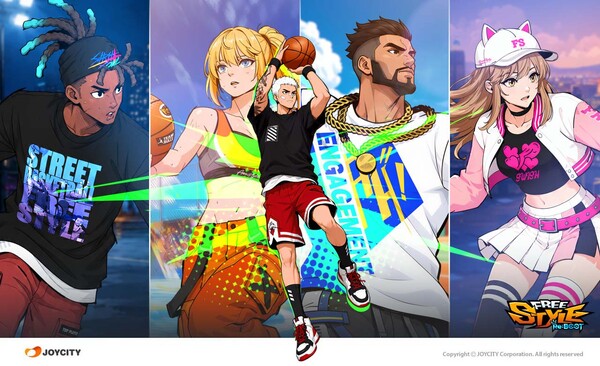
South Korean online games from the 2000s are returning. "Freestyle Reboot" has been released, and "Special Force Remaster" is set to begin full service. Nexon is pursuing both the modernisation of existing games and the reuse of old intellectual property (IP) through "Mabinogi Eternity" and "Replay."
◆Modernising directly by updating engines and systems
"Freestyle Reboot," which JoyCity began servicing on Aug. 13, is a title that reconstructs the 2004 PC online basketball game "Freestyle" with a new engine. It keeps the original framework, including 3-on-3 real-time matches, while improving graphics and character movement and reducing reliance on item stats.
After launch, work has also continued to narrow the skill gap between existing and new users. JoyCity adjusted rebound trajectories and matchmaking for beginners, but readjusted some changes just one day after a patch. It is seeking a balance between preserving a feel familiar to existing users and lowering barriers for new users.
DragonFly is preparing full service for "Special Force Remaster." The original, released in 2004, is an FPS that ranked No. 1 in PC cafe game charts for 79 consecutive weeks and secured 6 million cumulative registered members in South Korea.
The remaster applies Unreal Engine to improve graphics while keeping the original control feel, including gun recoil, fast combat tempo, diagonal movement and the ghost step. It reduced P2W (Pay to Win) elements and added a training ground and tutorials to lower barriers for new users. It also plans to reflect user feedback from early access that began in March in the full version.
Nexon's "Mabinogi Eternity" is also part of the same trend. It is a project to introduce Unreal Engine to the MMORPG "Mabinogi," which began service in 2004, improve character appearance and background graphics, and overhaul overall elements including gameplay convenience, life content and sound.
Nexon conducted its first alpha test from Sept. 3 to 6 to check key paths from early growth sections to combat and life content. It plans to reflect user play patterns and survey results collected in the test in future development. Rather than making a separate new title, it is changing the foundational technology and user experience of a game currently in service.
"Freestyle Reboot," "Special Force Remaster" and "Mabinogi Eternity" differ in details, but share the point that they keep the core experience of the original while reworking engines and systems to fit the current user environment.
◆Nexon opens older game IP itself to outside parties
Nexon is directly modernising games currently in service and opening past IP that has become less utilised to outside developers.
In December last year, Nexon disclosed five IPs: "The Legend of Darkness," "Elancia," "Asgard," "Tactical Commanders" and "Everplanet." It provided development teams with core resources such as graphics and sound and simplified contract and review procedures. It also applied a structure that allows multiple developers to use the same IP on a non-exclusive basis.
Development is under way. "Tactical Commanders" is being developed by Chogasoft as a remastered version, while "Elancia" has multiple projects under way, including an MMORPG remaster and a mobile RPG. "Everplanet" is being reinterpreted as an MMORPG, and "The Legend of Darkness" as a mobile RPG.
◆Beyond simple re-releases to 'redesign' as IP strategies also change
The strength of past IP is already-established awareness and fandom. Game companies can reduce the burden of promoting a new IP from scratch while reintroducing familiar games for the current environment.
Recently, the use of older IP has been moving closer to redesign for today's user environment than to simple re-releases. The direction is to use past awareness and fandom while changing technology, systems and service methods so current users can accept them.
With the scale and cost of new game development rising, existing IP can be an option to lower development risk by using an already-formed fan base and awareness. But past awareness does not guarantee success. This is why "Freestyle Reboot" and "Special Force Remaster" are putting effort into lowering barriers for new users.
In the end, the key is not how faithfully the original is restored, but what is kept and what is changed. If a title relies only on existing users' memories, it is difficult to broaden the user base, and if the extent of change is excessive, it can lose the experience original fans expected.
An industry official said, "Popular IP from the past has the strength of already being known to users, but it is difficult to create long-term success with nostalgia alone." The official added, "It is important to choose a way to use owned IP that fits the current situation and to change it so current users can easily access it while keeping the original's core fun."
 Ho-jeong Lee
lhj@d-today.co.kr
Ho-jeong Lee
lhj@d-today.co.kr