
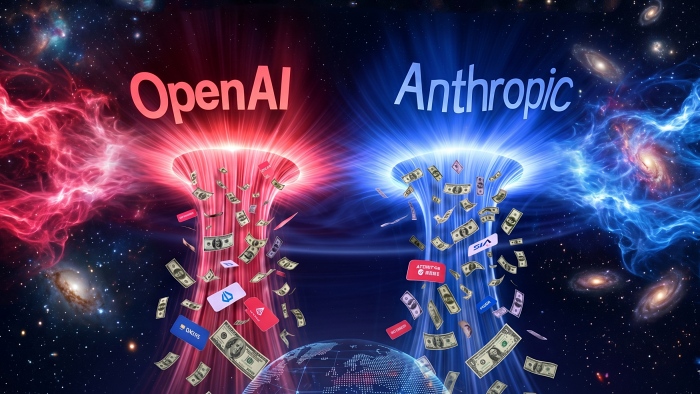
As venture money pours into OpenAI and Anthropic, global investment firm Insight Partners has drawn a line against excessive concentration in a single artificial intelligence (AI) company. It rates the AI market’s growth potential highly, but says it will keep a diversified strategy while weighing valuation levels and the ability to exit investments.
On Sept. 13 local time, IT outlet TechCrunch reported that Insight Partners co-managing partner Devyn Parekh (데빈 파레크) said at a recent conference that, over the long term, diversification rather than focusing capital on one company has produced better results.
Insight Partners holds stakes in both OpenAI and Anthropic. It is not choosing to concentrate a large portion of fund capital in either one of them. Parekh explained that some funds are currently raising money with a strategy of investing 35 to 40 percent of their total capital into either OpenAI or Anthropic.
Insight Partners, which has managed 13 funds to date, stressed that it places greater importance on long-term performance across multiple funds than on the performance of any single fund or company.
Parekh acknowledged that, if viewed only at the current point in time, the firm might have posted higher returns if it had put 25 percent into Anthropic. He said long-accumulated investment data does not support excessive concentration, and that most limited partners also do not want an overly high weighting in a single company.
He also signaled caution about elevated valuations in the AI market. Parekh said the venture investment market is heating up to levels similar to 2021, and pointed out that the outcome then was not good.
Typically, later investment rounds for startups command higher valuations as more business data accumulates and risk declines. But in the recent AI investment market, rounds are moving too quickly, he said, driving valuations sharply higher even before sufficient data has built up.
As a result, Insight Partners prefers a strategy of investing relatively small amounts at an early stage and then making additional investments in companies whose growth performance is confirmed, rather than deploying large sums at once in later stages.
Parekh said returns benefited more from investing $20 million to $25 million first and then expanding investment in companies after performance is confirmed than from investing $500 million in one go.
He cited cybersecurity company Wiz as a representative example. By continuing to invest as the company grew after an initial investment, the firm was able to secure much larger returns than if it had stopped after the first investment.
It also considers capital returns and liquidity management important. Parekh said many venture funds raised large amounts of money in 2021 to 2023 but were unable to return enough cash to limited partners.
He said he also advises other fund managers that even if a particular AI company’s valuation could rise further, there is a need to recover principal first. He said what matters to limited partners is whether they can actually turn holdings into cash, rather than the marked value of assets.
Parekh acknowledged that Insight Partners has also delayed selling in the past due to expectations that valuations would rise further. He said it returned more than $20 billion to limited partners over the past two years through strategic stake sales and initial public offerings, with additional realizations planned.
He also pointed to the possibility of AI companies listing on stock markets. Parekh mentioned that Anthropic may move to file for a listing soon, and he expected OpenAI could follow.
He added that listings by ultra-large AI companies do not immediately become a new benchmark for the entire market. He said companies that could exceed a $1 trillion valuation, such as SpaceX, Anthropic and OpenAI, may list over the next 6 to 8 months, but what matters more is the valuation standard used by the next tier of companies when they enter public markets.
He maintained a positive outlook on AI technology itself. While acknowledging that open-source AI models could be misused, Parekh said AI’s positive effects would be greater, such as accelerating new drug development and bringing forward disease treatments.
He took a relatively cautious stance on physical AI areas including robotics. He said related companies are still closer to a scientific project stage, and must simultaneously resolve two uncertainties: real commercialization and large-scale adoption of robots.
Ultimately, Insight Partners’ strategy is focused not on denying the AI investment boom but on managing concentration, valuation and exit feasibility during an overheated phase. Even as interest grows in ultra-large AI companies such as OpenAI and Anthropic, it aims to maximize returns by investing small at an early stage, increasing capital into proven winners, and cashing out at an appropriate time.
 Jinju Hong
hongjj@d-today.co.kr
Jinju Hong
hongjj@d-today.co.kr