
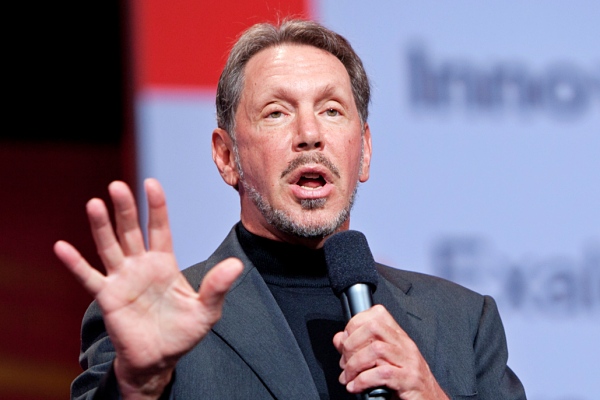
Oracle co-founder Larry Ellison withdrew a plan to sell up to $7.5 billion worth of Oracle shares a day after it was disclosed.
On Sept. 12, major foreign media outlets including blockchain publication Cryptopolitan reported that Oracle said Ellison had not sold any shares under the plan and has no other plan to sell Oracle stock.
The plan first emerged in Oracle’s latest quarterly report. Ellison was approved to sell up to 50 million Oracle shares by the end of October, but the company reversed it after a day. Oracle gave no separate explanation for the withdrawal. Based on the Sept. 11 closing price of $150 per share, the shares eligible for sale were worth about $7.5 billion.
Market attention is moving beyond whether an insider sale will take place to Oracle’s cash flow and the burden of AI investment. Oracle said on Sept. 11 that revenue in its data centre segment improved, but investors continue to examine pressure on profitability from expanding AI infrastructure. The company’s shares have remained weak amid concerns about shrinking margins.
Oracle has recently been restructuring its business to match rising data centre demand from AI companies. It is accelerating efforts to secure large-scale computing resources and data centre capacity as it pursues a major project with OpenAI. But the process has not been smooth. The project involved permitting and regulatory issues, and the company used both borrowing and new share issuance to raise funds.
The cost burden is also evident in workforce restructuring. Oracle said it will book an additional $700 million in retirement-related costs over the next year. In the previous fiscal year, it spent $2.1 billion on retirement costs alongside laying off tens of thousands of employees. This shows that expanding AI investment is increasing growth opportunities while also affecting the cost structure.
Ellison is currently the largest single shareholder, holding a 40 percent stake in Oracle. According to the company’s latest proxy materials, he pledged 346 million Oracle shares as collateral for personal borrowings as of September 2025. The funding is also linked to major projects outside Oracle. In December last year, he agreed to personally support a $40 billion equity raise tied to his son David Ellison (데이비드 엘리슨)’s proposal to acquire Warner Bros. Discovery.
Ellison did not participate in the recent earnings conference call, but he is reported to remain involved in internal decision-making. A close associate said Ellison is still “very active”. Oracle’s AI data centre business is also an area he has directly backed.
Market views on Oracle’s results are mixed. Jim Cramer cited backlog as a key indicator in a broadcast on Sept. 11, focusing on Oracle’s first-quarter financial statements. “There is about $332 billion in contracted business,” he said. “Two years ago this figure was only $99 billion. The scale of the opportunity has changed dramatically.” He added that this quarter’s earnings release was calm and normal, and he saw Oracle as bringing new facilities online, receiving customer funds and keeping its spending outlook under control within its current plans.
The withdrawal is meaningful in that it has temporarily eased supply-demand concerns tied to the largest shareholder. But Oracle is in a phase where AI infrastructure expansion, increased borrowing and rising restructuring costs are moving in parallel. As a result, the market is expected to keep watching the pace of execution and margin defence in OpenAI-related business, as well as whether additional fundraising will take place.
 Jinju Hong
hongjj@d-today.co.kr
Jinju Hong
hongjj@d-today.co.kr