
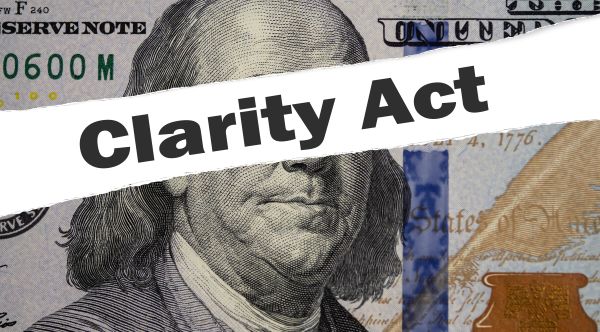
A revised version of the crypto Clarity Act has been released five days before a key vote in the U.S. Senate.
On Sept. 10, foreign media reported that Republican senators released a 630-page amended Clarity Act. The revision includes a requirement for DeFi trading protocols that are difficult to view as decentralised to register with the Commodity Futures Trading Commission (CFTC). It also includes provisions clarifying the scope of federal credit unions' use of digital assets.
The core of the revision is to specify requirements for recognition as decentralised finance. A protocol is not recognised as decentralised if a specific person or group can control or materially change its functions, if it is not operated solely by predetermined transparent code rules, or if someone can restrict use or censor it. Such non-decentralised trading protocols that allow control or material changes may be subject to CFTC registration.
It does not, however, consider a person to be controlling a protocol solely because they participate in decentralised governance or sit on a security committee to respond to security incidents. The amended DeFi-related rules also clarified the scope to focus on spot and cash transactions of digital commodities.
It also added provisions related to federal credit unions. The revision allows federal credit unions to use digital assets or distributed ledger systems in carrying out or providing legally permitted activities and functions, goods or services. It also made technical changes to some wording of the GENIUS Act so that credit union accounts can have a status more equivalent to bank deposits in connection with tokenised financial products. Supervisory and enforcement authority of regulators such as the National Credit Union Administration (NCUA) remains in place.
The Clarity Act aims to establish a federal digital asset market structure by classifying digital assets as securities, commodities or stablecoins and dividing oversight authority between the Securities and Exchange Commission (SEC) and the CFTC. If the bill passes, an institutional foundation would be 마련 for most cryptocurrency activity in the United States, and fundraising through token sales is expected to become easier.
The Senate is set to hold a procedural vote on Sept. 15 to move forward with discussions of the bill. The vote is not a final passage vote but a procedure to allow full deliberations to proceed. Republicans need to secure support from Democratic lawmakers to advance the bill.
But despite the release of the revision, the sides have not reached a bipartisan agreement. Democrats argue that ethics provisions targeting U.S. President Donald Trump and his family's cryptocurrency interests are insufficient. A Democratic source pointed to unresolved ethics issues as the biggest obstacle to the bill.
The Clarity Act passed the House in July last year, but action in the Senate was delayed as banks and the crypto industry clashed over the issue of paying returns on stablecoins. In July, ethics provisions were also added to limit public officials and their spouses from issuing or sponsoring digital assets.
Republican Senator Cynthia Lummis (신시아 루미스) urged support for the bill, arguing that the revision reflects more than 100 changes requested by Democrats. Lummis said it includes limits on participation in digital asset markets by people with histories of fraud, $150 million in support for the CFTC, and tighter regulation of platforms such as Binance.
Earlier, Trump also urged Congress in August to pass related legislation, saying the United States must do so to maintain a leading position in bitcoin and cryptocurrency.
The Sept. 15 vote is expected to be a watershed moment to gauge whether the Clarity Act can secure bipartisan support and move to the next stage.
 Seungah Yoo
ysah@d-today.co.kr
Seungah Yoo
ysah@d-today.co.kr