
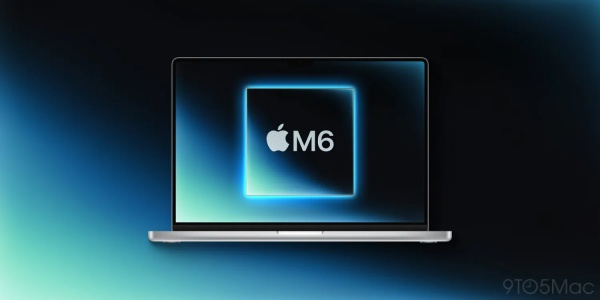
[DigitalToday reporter Jinju Hong] Apple is expected to launch an M6 MacBook Pro with a 14-inch display this fall.
According to IT outlet 9to5Mac on Tuesday (local time), the new product keeps the current design while focusing on improving AI processing performance, baseline computing performance and power efficiency with the M6 chip.
The upgrade centers on the M6 chip. For users doing more AI-related work, a stronger Neural Engine is cited as the biggest change. The M6 uses a dual 16-core Neural Engine, replacing the 16-core Neural Engine used in the M5 and earlier chips. With AI use potentially expanding further in macOS 27, users running related workflows could see a larger perceived difference.
The base chip configuration is also upgraded. The base M6 provides a 12-core CPU and a 12-core GPU. That is an increase from the M5, which stayed at 10 cores for each. Apple also, for the first time, includes three types of CPU cores in the base chip: 2 super cores, 4 performance cores and 6 efficiency cores.
Apple explained that the super cores handle single-thread tasks quickly. It also said the performance cores use less power while working with the super cores on high-load multithread tasks, and the efficiency cores handle everyday background tasks. Until now, a structure that uses super cores and performance cores together was offered only in the M5 Pro, M5 Max and M5 Ultra, but this time the range expands to standard M6 users as well.
Improved power efficiency is also a key point. The M6 is the first Apple chip to use a 2-nanometre process. Apple said this delivers a large leap in performance and power efficiency. For now, the only product with the M6 is a new Mac mini that does not use a battery, but in upcoming battery-powered products such as the MacBook Pro and MacBook Air, the change could show up more directly.
In laptops, improved power efficiency is directly tied to battery life. Apple may still adjust physical battery size, but if the M6's efficiency gains hold, there is room for the new MacBook Pro to deliver longer battery life.
This product can be summed up as an upgrade weighted more toward a chip transition than a design change. Screen size remains 14 inches and the design carries over from the current model, but AI computing, CPU and GPU configuration and power-efficiency gains from the process shift are central. As a result, the M6 MacBook Pro expected to be unveiled this fall is likely to aim to change the user experience through chip performance improvements rather than design innovation.
 Jinju Hong
hongjj@d-today.co.kr
Jinju Hong
hongjj@d-today.co.kr