
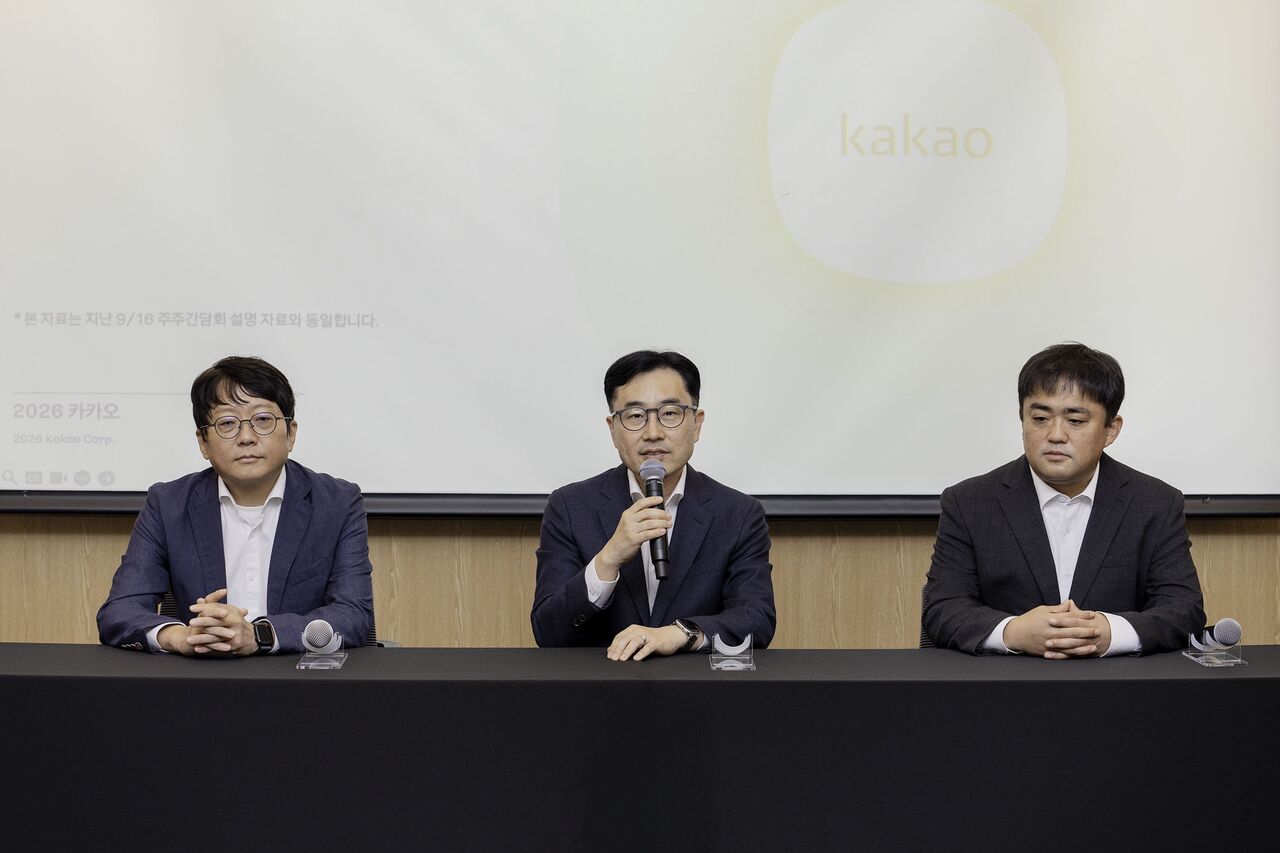
Kakao denied a possible block deal and rumours of selling major affiliates that have been raised ahead of its planned corporate spin-off. As minority shareholders voiced concerns about a post-split share price fall and damage to corporate value, the company also said it will prepare measures to reflect share price and shareholder value in its executive compensation system.
Kakao held a meeting with minority shareholders on the 20th at the FKI Tower in Yeouido, Seoul, and answered shareholders' questions related to the corporate spin-off. Following an online meeting in September, the event proceeded without a separate presentation of materials and focused on questions and answers from shareholders attending in person and online.
Concerns about share price and corporate value after the spin-off were raised intensively at the meeting. In particular, a shareholder said KakaoAI's share was too low in the current spin-off plan, where the split ratios for KakaoAI and KakaoX are about 36 percent and 64 percent, respectively, and pointed to the possibility that the combined enterprise value of the two companies could decline.
Kim Do-young (김도영), designated CEO of KakaoX, explained that the split ratio is used to allocate the number of shares based on net asset value and does not mean the ratio of actual enterprise value. He said the enterprise value of the two companies will be evaluated by the market after relisting, and the split ratio could also be partially adjusted later.
Questions also continued about whether KakaoX's enterprise value can be properly evaluated. Kakao plans to disclose in more detail the performance and growth plans of major subsidiaries after the split and clarify shareholder return measures for investment performance to lower the corporate value discount rate.
◆ Denies block deal and affiliate sale rumours, draws a line on share price fall concerns
The possibility of a block deal by the controlling shareholder after the spin-off also emerged as an issue. When a shareholder raised concerns about the possibility of a block deal by Kakao founder Kim Beom-su (김범수) and a resulting share price fall, Shin Jong-hwan (신종환), Kakao's chief financial officer, denied the rumour, saying, "There will be no block deal."
Shin said management also takes the sluggish share price seriously. He added that the spin-off is a decision to improve the business structure, and that all shareholders will be allocated shares in the two companies according to the split ratio.
It also ruled out the possibility of selling major affiliates such as KakaoBank and KakaoPay. A shareholder asked about the truth of rumours that KakaoX may seek to sell subsidiaries it holds after the split.
Kim said, "This spin-off has nothing to do with the sale of subsidiaries," adding the rumours have never been discussed and have not been reviewed or considered.
However, on the issue of initial public offerings for Kakao Mobility and Kakao Entertainment, it said existing financial investors hold rights under shareholder agreements. It said future decision-making will comply with contractual rights and legal procedures while protecting the value of existing Kakao shareholders.
◆ Reflecting share price in executive pay, reaffirms 300 billion won shareholder return
Management's responsibility for a share price recovery was also raised as a key question. A shareholder asked whether there is a mechanism to hold management accountable, such as cutting or returning performance bonuses, if shareholder value does not recover even after the spin-off.
Kakao responded that it will set key performance indicators, or KPIs, suited to each company's business characteristics after the split and link them to management evaluation and compensation. KakaoAI is preparing an evaluation system focused on business performance, while KakaoX is preparing a system focused on investment performance and reducing the discount rate applied to the value of subsidiaries it holds.
Kim said he will consult with the newly formed board of directors to set a compensation system so that share price and shareholder value can be reflected in management bonuses and incentives. He did not make a specific commitment on whether bonuses would be returned or reduced in the event of a share price fall.
On shareholder returns, it reaffirmed previously announced plans. KakaoAI plans to raise its shareholder return ratio to as high as 40 percent if its standalone adjusted free cash flow increases by more than 50 percent from the previous year. KakaoX will use 30 percent of after-tax dividends received from subsidiaries and up to 30 percent of investment gains after deducting taxes and capital costs for shareholder returns.
Kim also stressed an existing plan to use gains from Kakao Investment's sale of its stake in Dunamu to buy back and cancel treasury shares worth 300 billion won over three years after the split.
Questions were also raised about procedures for pursuing the spin-off. Kakao said it is responding to items requested during the review process based on related materials submitted to the Korea Exchange, and is also providing explanations on the specificity of KakaoAI's business plan.
It did not give a definitive answer on whether it would try again if the spin-off proposal is voted down at an extraordinary general meeting of shareholders on Dec. 17. Shin said it should be judged again based on the vote result and shareholders' opinions, and that it is difficult to decide at this point whether to pursue it again.
Kakao's policy is to separate KakaoAI's platform and AI business from KakaoX's affiliate investment and management functions through the spin-off, focus on growth in each business and raise corporate value. Minority shareholders, however, are demanding an actual share price recovery and accountable compensation for management after the split, and the company is expected to continue efforts to persuade shareholders until the extraordinary meeting in December.
 Lee Ho-jung
lhj@d-today.co.kr