
[DigitalToday reporter Seul-gi Son] Industrial AI company Makinarocks presented a vision of building fully autonomous factories in South Korea by 2028, without human intervention at manufacturing sites.
Sung-ho Yoon (윤성호), CEO of Makinarocks, said at the “Attention 2026” event held on Sept. 3 at The Westin Josun Seoul Parnas in Seoul’s Gangnam district, “When humanity leaves Earth and builds a civilisation on Mars, the company that builds a fully autonomous factory the fastest will be Makinarocks.”
To that end, Makinarocks is carrying out a fully autonomous factory project with domestic electric actuator company EnerTalk. It has identified more than 80 AI transformation tasks so far. From 2026 to 2028 over three years, it plans a step-by-step transition to a “visible factory” that identifies factory conditions, a “connected factory” with connected equipment and systems, and then an “autonomised factory” that acts on its own.
Yoon also disclosed AI application results in manufacturing and defence sites that support the plan.
Makinarocks applied an AI agent to work reviewing changes to design documents, cutting working time by about 1,000 hours. In six global auto production processes, AI manages 1,400 industrial robots together with people.
Makinarocks AI technology was also piloted in a recent South Korea-U.S. combined exercise. According to the company, it built GPU servers and an AI operating system in a defence-focused environment to support commanders’ document searches and the drafting of operation reports, as well as cause analysis and suggested response steps when problems occur.
Yoon introduced this as “the first case of AI being introduced into South Korean military training.”
Makinarocks’ focus on industrial sites stems from its view that performance gains in general-purpose AI are not sufficiently leading to actual improvements in corporate productivity.
Citing findings from the U.S. National Bureau of Economic Research (NBER), Yoon explained that about 90 percent of companies over the past three years have not experienced tangible productivity improvements from adopting AI.
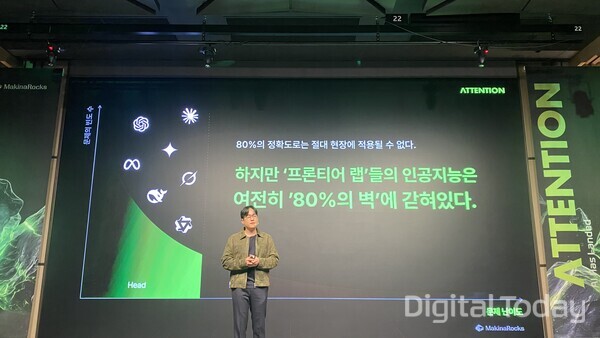
He said that in manufacturing and defence sites, reliability that can handle exceptional situations is more important than high average accuracy. “The field is a space where it can never be applied with only an 80 percent probability,” Yoon said. “Makinarocks has focused on overcoming this 80 percent wall, solving the long-tail problem, and making AI that can actually work on site.”
Yoon underscored “enterprise AI sovereignty” as the competitiveness of its AI platform, Runway. He said it allows companies to directly own and trace data and AI outputs, and to control AI usage rights and records without being dependent on any particular foundation model or cloud or infrastructure provider.
Runway was designed to use internal corporate data for AI and to accumulate outputs, while allowing a choice among various external and open-source models and infrastructure.
The company is also expanding its forward deployed engineer (FDE) organisation to implement on-site AI. Makinarocks’ FDEs have visited more than 80 sites across 32 cities in five countries so far. The company explained that it投入 about 700,000 hours this year on applying on-site AI and has applied more than 6,000 AI models to real sites to date.
“From factories to battlefields, we will build AI that operates in the roughest and most unpredictable environments,” Yoon said. “Through this, we will achieve fully autonomous manufacturing and hyper-productivity.”
 Seul-gi Son
sageson@d-today.co.kr
Seul-gi Son
sageson@d-today.co.kr