
Global voice AI company ElevenLabs is pushing to build data residency in South Korea. It aims to respond to local companies’ data security and storage requirements and speed up its push into the enterprise voice AI market. A specific rollout timeline has not been set.
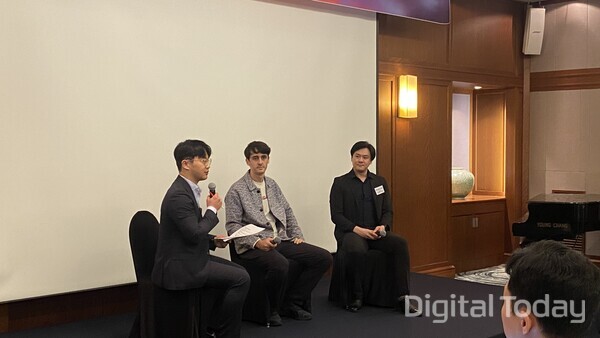
Eugene Liang (유진 리앙), ElevenLabs’ Asia-Pacific (APAC) head, said at an “ElevenLabs Executive Breakfast Session” held on Sept. 3 at Novotel Ambassador Seoul Gangnam in southern Seoul that data residency is in place in Singapore and discussions are under way to introduce it in South Korea.
Data residency is a system that allows companies to store and manage the data they generate and process within a specific country or region. For companies handling sensitive data in areas such as finance and telecommunications, key considerations when adopting generative AI include whether data is transferred overseas and where it is stored.
ElevenLabs explained that until domestic data residency is in place, it provides options such as a “zero retention” approach, depending on enterprise customer requirements, that does not store data on its platform.
Liang said at the event that there is a zero retention approach that does not store interactions conducted through the platform. He said the company would build a data residency roadmap tailored for South Korea and aims to show it soon. After the event, he did not specify a timeline when asked about a concrete launch date, saying related discussions are progressing positively.
ElevenLabs is pushing to expand its business in the South Korean market, focusing on enterprise voice agents and content localisation. Voice agents are services in which AI understands human speech and responds in natural language while carrying out tasks such as customer service.
Liang introduced cases among overseas companies that have fully adopted voice agents for inbound and outbound conversations. He said it was a global trend and a use case suited to South Korea, adding he expects opportunities to expand further domestically.
He also rated South Korea highly as a testbed for new voice AI services. He said that as voice AI advances, new forms of interaction between humans and AI that the company has not yet envisioned will emerge. He said he did not think there is a market as suitable as South Korea for incubating new use cases that could be a game changer for companies.
In customer service, he predicted roles will be reshaped so that AI does not uniformly replace staff but handles repetitive consultations or sudden spikes in demand, while people focus on tasks that require complex and emotional responses.
Liang said AI can fill gaps when demand suddenly increases or staffing is short. He said that as use cases AI can handle expand, people will be able to take on more complex work with higher emotional value.
ElevenLabs is also preparing its next-generation voice AI model, V4. V4 is expected to include functions that go beyond expressing emotions such as sounding happy or crying, and instead reflect context to control speech more precisely.
Liang explained that if users provide context such as a professional or calm situation, the model can pronounce accordingly. He said in some languages, words are pronounced differently depending on context, and improvements in this area would be particularly meaningful for East Asian languages.
Nathan Benaich (네이선 베나이치), founder and general partner of Air Street Capital, who delivered a keynote speech on the day, said on global frontier model competition that Anthropic and OpenAI models are mostly in the top tier, but Chinese open-source models are quickly catching up and South Korean models are not far behind.
 Seulgi Son
sageson@d-today.co.kr
Seulgi Son
sageson@d-today.co.kr