
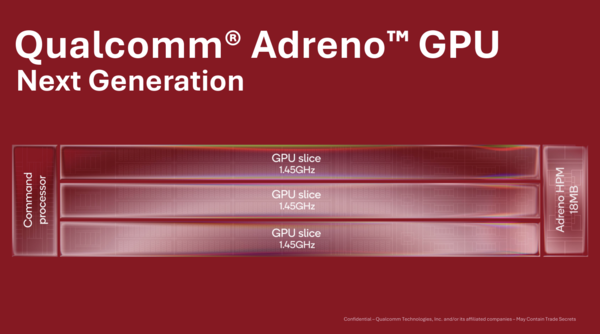
Qualcomm has for the first time added dedicated cores for artificial intelligence calculations to a GPU, a chip that handles graphics processing. On Sept. 2 Qualcomm unveiled an updated architecture for the Adreno GPU used in its next-generation premium platform and introduced an AI-based rendering technology called Adreno Neural Fusion. The company said it achieved improvements in both graphics performance and power efficiency, calling the change its biggest generational leap to date.
Qualcomm used a three-slice GPU architecture. While keeping that structure, it raised the operating frequency of each slice by 250 MHz. It also added 18 MB of Adreno High Performance Memory (HPM), dedicated memory mounted directly on the graphics chip.
HPM places memory close to compute blocks to reduce the number of times the chip accesses external DDR memory. Render targets, depth and color buffers, textures created in previous stages and intermediate computation results remain in this space. It is a structure in which tile-based rendering, frame buffers and compute tasks are processed inside the graphics subsystem. Qualcomm said it is confirming a 12 percent improvement from this architecture. It will disclose specific GPU performance figures at the Snapdragon Summit to be held this month.
By reducing the number of data transfers, latency shortens and the power burden also falls. This can help performance stay stable even during long gaming sessions. Qualcomm also placed an Adreno Matrix Core alongside this memory. It is a dedicated AI GPU core designed to run AI models directly inside the graphics pipeline. This is the first time a matrix core has been included in the Adreno line.
Matrix acceleration has expanded from the NPU, a chip dedicated to AI calculations, and the CPU to the GPU. That means AI processing functions now span the platform’s major compute engines. The company said there is no longer a need to send tasks outside the graphics pipeline to handle neural workloads. Developers can run complex rendering models with lower latency and less power.
Adreno Neural Fusion runs on this matrix core. It combines neural processing, super resolution that upscales a low-resolution image to a high-resolution one, and frame generation into a single graphics pipeline. It is designed to maintain a high frame rate while lowering a game’s power consumption. The duration of peak performance also increases.
Mobile upscaling has so far required accepting image-quality loss. Fine details would wobble, and fast-moving objects would leave trails. It also came with a problem of screens looking blurrier than native rendering. Qualcomm said Neural Fusion reduced such loss and improved detail retention and frame stability.
It has also secured game engine support. Integrated into Unity and Unreal Engine, it can be applied without additional implementation work by developers. Qualcomm described it as the first AI super resolution technology supported by major game engines. Commercialisation could start as early as this year. Game titles that apply the feature will be unveiled at the Snapdragon Summit to be held on Sept. 22 to 24.
 Daegeon Seok
d2dg@d-today.co.kr
Daegeon Seok
d2dg@d-today.co.kr