
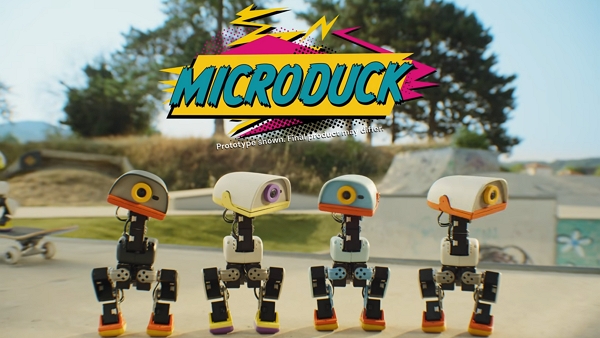
Microduck, a small bipedal robot introduced by Pollen Robotics, Hugging Face's French robotics unit, has sold more than 10,000 units shortly after launch. It has been assessed as showing the potential of the personal physical AI market by combining Chinese-made semiconductors and open-source software.
CNBC reported on Sept. 1 that Microduck topped 10,000 units sold within days of starting pre-orders on Aug. 27. The price is about $399, and even a simple calculation puts order value above $4 million. As orders came in faster than expected, delivery for new buyers was pushed back beyond the original target of Christmas 2026.
Microduck is a duck-shaped, bipedal robot that stands 25 cm tall and weighs about 800 grams. It has 15 motors, a front camera, lidar and 2 inertial measurement units (IMUs). It can walk, sit, stand back up after falling and pick up objects. Users can also control it directly with a gamepad.
Its brain uses Rockchip's RK3566 processor from China. The chip is based on technology from Britain's Arm and includes an AI accelerator. It has 1GB of memory and 32GB of storage. Rockchip is expanding its presence in chips for machine vision and AIoT devices, and its revenue in the first half of this year rose about 41 percent from a year earlier to 2.88 billion yuan, about 586.1 billion won.
Another feature of Microduck is its software openness. Its SDK, physical simulation and reinforcement learning tools are open, allowing users to train new motions in a virtual environment and then apply them to the real robot. It is not, however, open-source hardware with its mechanical and electronic design files 공개.
Pollen Robotics was acquired by Hugging Face in April last year. Microduck is its second consumer robot after the desktop robot Reachy Mini, which has been supplied in more than 10,000 units. With a combination of low-cost computing chips and open AI tools, attention is on how quickly a market for robots that individuals can train and modify themselves can grow.
 Jae-won Choi
ittt_0801@d-today.co.kr
Jae-won Choi
ittt_0801@d-today.co.kr