
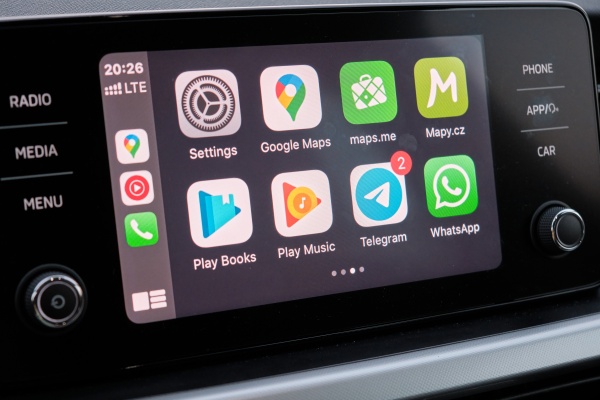
[DigitalToday reporter Jinju Hong] There is a view that it is not always safer to keep the protective film attached to a new car’s CarPlay infotainment screen.
On Sept. 1 local time, IT outlet Engadget reported that in some vehicles the transparent film can absorb heat and stick to the screen, potentially damaging the display, so owners should first check whether it should be removed.
The issue is that the film can look like temporary protective plastic used on smartphones or tablets, making it easy to assume it can be used the same way on an in-car screen. Many people leave it on to prevent smudges or scratches right after buying a new car, but the same approach does not work for every vehicle.
A warning drew attention after a mechanic’s TikTok video spread recently. The mechanic advised removing the film and warned that leaving it on could cause it to become stretched and stuck, damaging the screen underneath. The mechanic added that repair costs could run to thousands of dollars.
It was also raised that the warning cannot be applied to all vehicles as-is. Display materials and finishing methods differ by vehicle, and the film also needs to be distinguished as a temporary shipping cover or an actual protective attachment. Removing it arbitrarily after a wrong judgment could instead damage the vehicle screen.
The key is to first confirm the film’s purpose. If it is a temporary attachment meant to prevent scratches during shipping, keeping it on long term may not be appropriate. If it is a protective layer intended for use, removing it hastily could be more risky. The mechanic’s advice was clear, but it comes with the condition that not every car and not every protective film is the same.
As vehicle infotainment screens have grown larger and CarPlay use has become widespread, the issue has become tied to repair costs beyond simple care tips. Screen damage does not stop at appearance and can also affect operation of key in-car functions. Consumers therefore need to check what type of film is applied to their vehicle, rather than assuming leaving it on for a long time always provides protection.
The case shows that even if a car display looks similar to a smartphone, care methods are not necessarily the same. Since a measure left in place to protect the screen can instead become a source of damage, the decision on whether to remove it should be made after first reviewing vehicle-specific conditions.
 Jinju Hong
hongjj@d-today.co.kr
Jinju Hong
hongjj@d-today.co.kr