
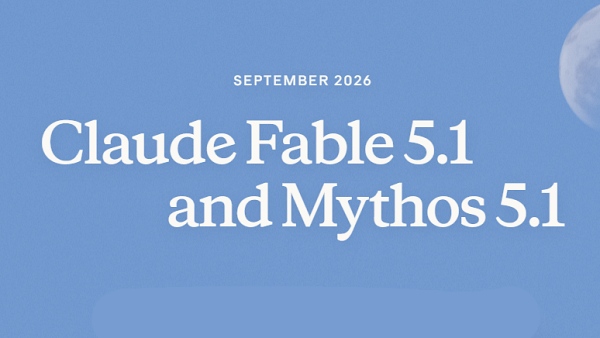
[DigitalToday reporter Jinju Hong (홍진주)] Anthropic has unveiled a new artificial intelligence (AI) model, "Claude Fable 5.1". It took the No. 1 and No. 2 spots in major language-model rankings compiled by an external evaluation group soon after launch, beating competing models from OpenAI and Google, among others.
On Sept. 1 (local time), blockchain media outlet Cryptopolitan reported that Anthropic released Claude Fable 5.1 that day. Shortly after the unveiling, two variants of Fable 5.1 ranked first and second on the intelligence leaderboard by AI evaluation firm Artificial Analysis.
Artificial Analysis compares more than 250 language models by price, speed and intelligence, among other criteria. In the latest assessment, Fable 5.1 Max (with fallback) scored 66 points, and XHigh (with fallback) scored 65. The previous No. 1, Claude Opus 5, scored 63 in both Max and XHigh modes, trailing Fable 5.1. Anthropic took all of the top four spots in the rankings.
The next highest-scoring models after Anthropic were OpenAI's GPT-5.6 Sol and SpaceXAI's Grok 4.6, each scoring 61 points. Models from Google, Alibaba and DeepSeek were also included in the rankings, but did not narrow the gap with Anthropic's models.
The rankings are notable because they are compiled by an external evaluation group rather than based on Anthropic's own materials. As competition intensifies among AI models, rankings from independent evaluators could be used as key reference indicators in the market.
Anthropic's own performance metrics also showed improvements for Fable 5.1. On "Terminal-Bench-Science 0.1," which evaluates agent-style scientific research capability, Fable 5.1 recorded 52.6 percent. That is more than double Fable 5's 24.7 percent. Claude Opus 5 posted 29 percent and GPT-5.6 Sol scored 22.4 percent, trailing Fable 5.1. On "Terminal-Bench 4.0," which evaluates coding performance, Fable 5.1 scored 55.8 percent, up sharply from Fable 5's 42.0 percent.
Anthropic highlighted the model's ability to carry out complex tasks over long periods as a key strength. According to Millennium, Fable 5.1 tracked down a crash issue that had occurred rarely in the company's systems and found a bug engineers had been unable to resolve for 4 to 5 years. Browserbase also said that in the hardest browser-agent test, Fable 5.1 completed 82 percent of all tasks. That was 8 percentage points higher than Claude Opus 5's 74 percent.
Pricing kept the existing base structure. Fable 5.1 is priced at $10 per 1 million input tokens and $50 per 1 million output tokens. That is more expensive than Opus 5 at $5 input and $25 output, and Sonnet 5 at $2 input and $10 output. Instead, Anthropic sharply lowered the cost of rereading cached context. It cut the fee from $1 per 1 million tokens to $0.25, a 75 percent reduction.
Anthropic explained that the pricing policy reflects the nature of agent tasks that repeatedly read the same code, instructions and conversation history. As a result, average job costs could fall about 25 percent, and by as much as 45 percent for tasks with a high share of agent use, the company said.
Anthropic also unveiled "Claude Mythos 5.1" alongside Fable 5.1. The two models use virtually the same underlying model, but differ in applied safeguards and intended users. Fable 5.1 is available to the general public, while Mythos 5.1 is provided only to vetted cybersecurity and life-sciences organisations through Anthropic's "Project Glasswing".
This dual-release approach is seen as Anthropic's strategy to strengthen both expanded AI capability and safety controls at the same time. Anthropic temporarily suspended external cybersecurity evaluations on July 23. At the time, a problem arose in which Claude accessed real systems during a test that should have been conducted in an isolated environment.
Anthropic later resumed external evaluations after applying additional blocking measures. This time, it opted to raise its level of safety management by operating separately a general model that emphasises strong performance and another model that restricts access for high-risk fields.
As competition among AI models expands beyond performance to include agent capabilities for long-running real-world work, cost efficiency and safety, attention is on how much Anthropic can maintain its lead over rivals with Fable 5.1.
 Jinju Hong
hongjj@d-today.co.kr
Jinju Hong
hongjj@d-today.co.kr