
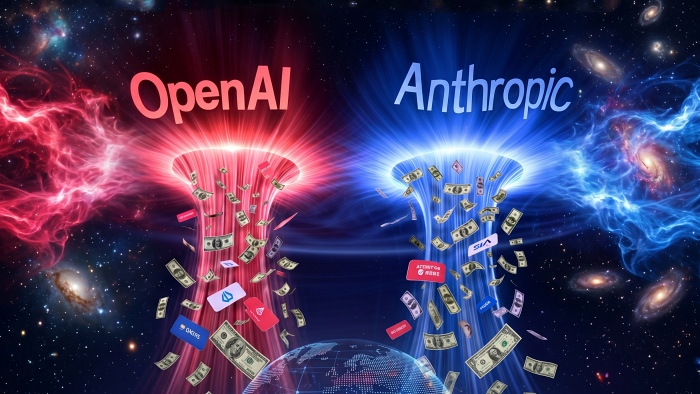
Anthropic and OpenAI, which are leading the race to develop advanced AI models, are unveiling new AI models. Attention is on whether they can deliver a meaningful counterpunch to Chinese companies closing in with cost-effective open-source models.
Anthropic released Claude Fable 5.1, an upgraded version of its top-tier AI model Fable, and lowered fees for some users.
Claude Fable 5.1 will be available to general users from the 1st. Access-limited Claude Mythos 5.1 can be used only by select partners that have been vetted in areas such as cybersecurity and life sciences.
Anthropic said Fable 5.1 improves performance in coding and multistep knowledge work compared with the version released in June. Base pricing is unchanged at $10 per 1 million input tokens and $50 per 1 million output tokens. It cut by 75 percent the cost of referencing or retrieving information Claude has already processed. Axios reported this would reduce the cost of running long-running AI agents.
OpenAI will also release a new model, Astra, soon.
Alex Heath (알렉스 히스), a tech journalist and former deputy editor of The Verge, reported after covering OpenAI that the company showed in an early-August private demonstration for VIP customers that Astra could coordinate multiple agents at once to solve math proofs, handle desktop software very quickly, and create slides and financial review materials.
Astra is designed to carry out tasks lasting from days to weeks, remember revisions and collaborate with other agents or people. Sam Altman (샘 알트먼), OpenAI's CEO, was reported to have said it would be "the first model to invent something actually meaningful."
It is also viewed as a substantial step forward in research automation.
OpenAI will provide advanced cybersecurity functions related to Astra only to some testers.
According to an Axios report, Astra is the first model OpenAI has internally designated as 'critical' on its cybersecurity risk scale. Amelia Glaze (아멜리아 글레이스), OpenAI's vice president for research, said at a briefing, "Astra can, without human involvement, find unknown security vulnerabilities in systems with multiple defenses and develop ways to exploit them."
 Chi-gyu Hwang
delight@d-today.co.kr
Chi-gyu Hwang
delight@d-today.co.kr