
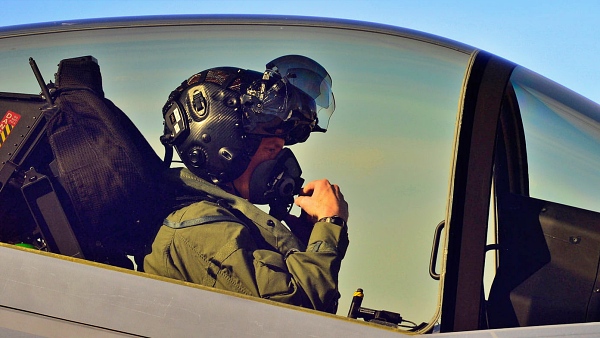
[DigitalToday reporter Jae-won Choi] An advanced helmet used by F-35 fighter pilots is drawing attention. Made to fit each pilot’s head, it goes beyond simple protection. It displays flight and combat information in front of the pilot’s eyes and provides a view that appears to see through beneath the aircraft, making it a core combat system.
On Aug. 31 local time, IT outlet TechRadar reported that the F-35 uses a third-generation Helmet Mounted Display System (HMDS). A U.S. Air Force estimate in 2015 put the price at about $400,000 each, or about 549.16 million won. That was more than four times the cost of earlier helmets used on aircraft such as the F-16. It is also designed to be precisely fitted for each pilot, including head shape and eye position.
The key is an augmented-reality view that links external sensors to the helmet. The F-35’s Distributed Aperture System (DAS) uses 6 infrared sensors placed around the aircraft to collect 360-degree imagery and send it to the pilot’s visor. When the pilot looks down, ground imagery is displayed instead of the bottom of the fuselage, allowing checks of the surroundings as if the aircraft had become transparent. It also provides aircraft and missile detection and tracking information.
The helmet also replaces the head-up display (HUD) found on existing fighter jets. Pilots can check speed, altitude, heading, targets and various sensor information without looking away, and it projects night imagery onto the visor. That is why the F-35 operates without a traditional fixed HUD.
The DAS’s long-range detection capability also stands out. In a 2010 test, an F-35 DAS mounted on a test aircraft detected and tracked a two-stage rocket launch from more than 800 miles away, or about 1,287 km. That does not mean a pilot can visually spot and immediately aim at a target 800 miles away.
Development did not go smoothly. Early versions raised issues including image jitter, display alignment, weight and ejection safety, and the U.S. Department of Defense at one point supported development of an alternative helmet by BAE Systems. After improvements were made, the replacement plan was scrapped. Manufacturer Collins Elbit Vision Systems delivered its 3,000th HMDS unit for the F-35 programme in 2024.
The F-35 helmet is less an expensive piece of pilot gear than a key interface linking the fighter’s sensors and the pilot. That is why former U.S. Air Force Chief of Staff Mark Welsh III (마크 웰시) described it not as a helmet but as a workspace.
 Jae-won Choi
ittt_0801@d-today.co.kr
Jae-won Choi
ittt_0801@d-today.co.kr