
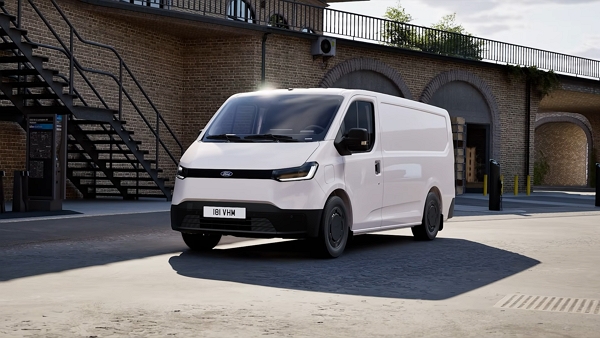
EV owners have been sharing accounts that their vehicles' real-world driving range significantly exceeds the U.S. Environmental Protection Agency's estimated rating. They say a vehicle can travel farther than its official figure depending on driving conditions such as low speed, smooth acceleration, use of regenerative braking and mild temperatures.
Electrek reported on Aug. 31 that a Ford E-Transit driver on the online community Reddit said the van, rated at 116 miles by the EPA, runs about 140 miles in summer. The driver said it was about 20 percent longer than the official figure even with about 1,800 pounds of cargo. The driver cited mainly using winding roads at around 40 mph and barely using friction brakes as reasons for the high efficiency.
Another user of the same vehicle also said it can run up to about 150 miles in summer. The user said they keep eco mode on, avoid hard acceleration and drive much of the time at relatively low speeds of 30 to 60 mph. Other users shared cases of high efficiency of about 5 mi per kWh or an estimated range display of up to 100 miles longer than the EPA figure. Some, however, said it was a dashboard estimate rather than a full charge-discharge driving range, and it needs to be distinguished from objective performance tests.
Such cases do not mean the EPA range standard is overly optimistic. The EPA instead lowers values measured in a laboratory to reflect real driving conditions. According to an official explanation, EVs undergo a laboratory driving test after a full charge, and the result is adjusted to account for factors not fully reflected in testing, such as air conditioner use, cold weather and high-speed or aggressive driving.
The most common method applies a correction factor of 0.7 to the test result. For example, a vehicle that logs 200 miles in a laboratory highway test could have its estimate lowered to 140 miles when real-world conditions are considered. The adjusted city and highway ranges are then combined at weights of 55 percent and 45 percent to produce the final EPA combined range. Manufacturers, however, may choose other approved correction methods under the rules.
EPA range is a standardised estimate that reflects various driving conditions, not a fixed value a vehicle must travel on a single charge. EV range tends to fall especially in high-speed driving and in the cold, while mild weather, low speeds, smooth driving and active use of regenerative braking increase the likelihood of exceeding the official figure.
 Jae-won Choi
ittt_0801@d-today.co.kr
Jae-won Choi
ittt_0801@d-today.co.kr