
Hecto Group is developing AI medical devices to help with early lung cancer diagnosis and recurrence prediction. Hecto's strategy is to advance its medical AI technology through participation in a state project and speed up its market push.
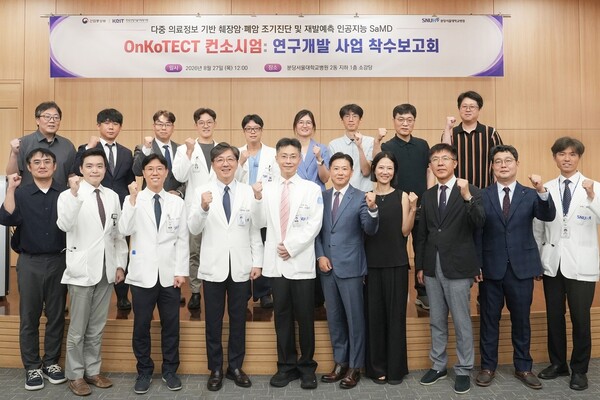
Hecto Group's dedicated AI unit, the HAI (Hecto AI) division, is participating in the OnKoTECT consortium centred on Seoul National University Bundang Hospital. It will carry out a state project in digital healthcare under the Ministry of Trade, Industry and Energy's Bio Industry Technology Development programme.
Hecto is responsible for developing LuTECT-1, an AI medical device that assists early lung cancer diagnosis, and LuTECT-2, an AI medical device that assists lung cancer recurrence prediction. Hecto plans to commercialise the products for use in medical settings such as general hospitals, health screening centres and national lung cancer screenings after approvals from the Ministry of Food and Drug Safety.
The OnKoTECT consortium led by Seoul National University Bundang Hospital (principal investigator: Jae-yong Kim (김재용), head of the Biomedical Research Institute) will receive 15.5 billion won in research funding through December 2030. Major domestic medical institutions and AI and data companies will pursue development and commercialisation of AI that can diagnose pancreatic and lung cancers early and predict recurrence.
The consortium was set up to link hospitals' clinical capabilities with industry technology so work can run from AI software development to clinical validation and approvals.
Hecto will support solving problems in medical settings by combining its in-house AI capabilities with real clinical data. Hecto is currently building in-house various systems including explainable AI, a federated learning system and MLOps, a machine learning operations framework that manages the entire process such as AI model development, deployment, operation and retraining, based on AI technologies including recommendation systems, computer vision, small language models and AI agents.
Yeon-uk Kim (김연욱), a professor of pulmonary medicine at Seoul National University Bundang Hospital in charge of the lung cancer area in the consortium, said AI technology that detects lung cancer early from images alone has already been developed in many places. He said the consortium will develop technology that uses multimodal data in six categories, including genomics and pathology as well as imaging, to predict early diagnosis and post-surgery recurrence.
A Hecto official said the national R&D project will be an important opportunity for Hecto to expand its AI capabilities into the medical field and be validated in the market. The official said Hecto will work closely with medical institutions and specialised companies in each field to develop AI medical devices that can provide practical help in early detection of lung cancer and post-surgery recurrence management, and later target global hospitals, screening institutions and the medical AI market.
 Chi-gyu Hwang
delight@d-today.co.kr
Chi-gyu Hwang
delight@d-today.co.kr