
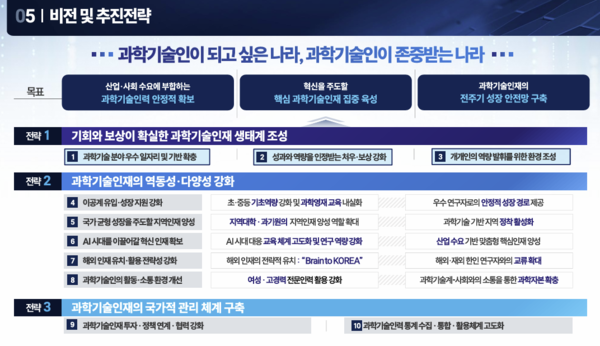
The government will fully launch a "national science and technology researcher" scheme under which the state directly identifies and supports world-class researchers, responding to a weakening base of science and engineering talent. It will increase the number of science and engineering scholarship recipients from about 3,000 to around 10,000, and attract 2,000 overseas top researchers by 2030.
The Ministry of Science and ICT on Aug. 31 confirmed the Fifth Master Plan for Fostering and Supporting Science and Technology Talent (2026-2030) after approval at the 9th deliberation meeting of the National Science and Technology Advisory Council.
The plan is the top-level statutory plan for science and technology talent policy over the next 5 years. It was jointly prepared by 11 ministries including the science ministry, the Ministry of Economy and Finance, the Education Ministry, the Industry Ministry and the Labor Ministry.
The government diagnosed a weakening supply base for science and engineering talent in South Korea due to a declining school-age population and preference for medical schools. With the number of new master's and doctoral graduates in science and engineering expected to decline after 2030, it plans to build a lifetime support system from entry and growth to employment and settlement.
Nurturing "national science and technology researchers"; scholarships to expand to 10,000
First, it will 추진 the "national science and technology researcher" scheme under which the state directly selects and supports top-level scientists and engineers.
For leader-level researchers, it will select 20 a year from 2026, for a total of 100, among world-class researchers aged 55 or under working in South Korea. For next-generation researchers, it will pick 200 a year from 2027, for a total of 1,000. Selected leader-level researchers will receive 100 million won a year in research activity funds, and next-generation researchers 50 million won a year, each for 3 plus 2 years.
It will also expand support for science and engineering graduate students. It will increase to around 70 by 2030 the number of universities receiving support for research living allowances, a "Korean-style stipend" that pays stable research funding to graduate students. The number of scholarship recipients, including the Presidential Science Scholarship, will also expand from about 3,000 to around 10,000.
It will also overhaul the alternative service programme for specialist research personnel. The government plans to revise the system so that 240 master's and doctoral degree holders in AI and AI transformation (AX) can serve at large companies and government-funded research institutes. It will expand research staff and quotas at government-funded institutes and at 4 science and technology institutes. It will also increase core research personnel and research jobs at universities to strengthen the foundation for young researchers to work in research with stability.
It will also institutionalise the status of postdoctoral researchers. The government plans to amend the Higher Education Act to specify postdoctoral researchers as official members of universities, and to foster "staff scientists" who handle research planning, research administration, equipment operations and technology commercialisation as a professional research support job group.
More gifted schools and 40 percent priority allocation of basic regional research
It will strengthen long-term support for researchers. For basic research, it will expand support so that, over the long term, 30 percent of all faculty members and 50 percent of full-time faculty members can receive funding, and it will increase long-term research of at least 10 years, such as "deep-dive research."
It will also revamp the education system to bring science and engineering talent into the pipeline earlier. It will build "intelligent science rooms" at schools nationwide by 2027 and establish 2 new gifted schools affiliated with science and technology institutes. It will also 추진 a plan to convert around 3 schools into gifted schools in regions without such schools. It will introduce and expand a fast track linking bachelor's, master's and doctoral programmes to help outstanding students grow into researchers faster than before.
To foster regional science and engineering talent, it will allocate at least 40 percent of basic research within the basic research programme to regions on a priority basis. Centred on regional flagship national universities, it will foster "brand colleges" and "specialised convergence research institutes" in regional growth-engine fields. It will also build industry-academia AX joint research centres in 9 fields between 4 science and technology institutes and regional universities.
Nurture AI talent and attract 2,000 overseas top researchers
It will also expand the system for training AI talent. It will broaden curricula from AI-focused primary and secondary schools to AI-centred and hub universities, AI colleges and AX graduate schools, and support research infrastructure such as GPUs.
It will also review introducing a tentative "industry degree system" under which people can earn doctoral degrees based on research and development achievements accumulated in industrial settings. It will also 추진 measures to revitalise in-house graduate schools within companies and a next-generation engineer training programme.
It will also move to secure overseas talent. It plans to attract 2,000 overseas top researchers by 2030 by expanding related programmes and visa systems. It will expand the scope of the top-tier visa and the K-STAR track, and strengthen package-type settlement support including housing and children's education. It also plans to ease restrictions on foreign researchers who earned doctorates in South Korea from participating in R&D so they can continue to remain in the domestic research field.
Bae Kyung-hoon (배경훈), deputy prime minister and minister of science and ICT, said, "In a complex crisis of global technological hegemony competition and low birth rates and a declining school-age population, the only way for South Korea to leap to a global leading country is ultimately people." He said, "We will build a lifetime ecosystem in which science and technology talent can feel pride, grow and play an active role."
 Jin-ho Lee
jhlee26@d-today.co.kr
Jin-ho Lee
jhlee26@d-today.co.kr