
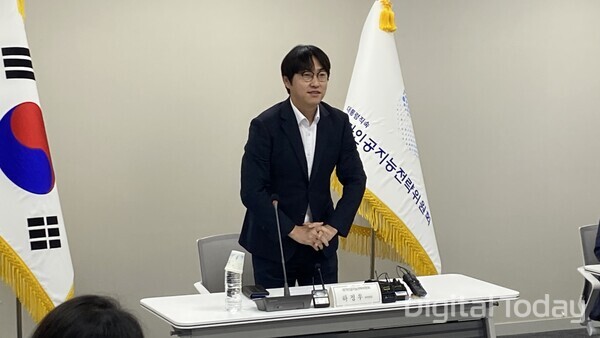
Ha Jung-woo (하정우), vice chairman of the National AI Strategy Committee, stressed that South Korea must secure national capacity to develop and operate frontier AI on its own, beyond developing a proprietary AI foundation model. He said narrowing the gap with the United States and China requires consolidating the country’s best capabilities beyond competition among individual companies.
Ha made the remarks at an inaugural news conference on Aug. 31 at the committee’s office in Seoul Square in central Seoul. "Rather than the idea of making one more model and releasing one more, we need to build the capability to create, develop and operate competitive AI on our own," he said.
He said frontier AI is not a concept limited to language models and that such foundations should be expanded to physical AI and other areas. He said the country needs its own capabilities not only to follow technological change but also to move ahead when needed.
Ha said there are limits to domestic companies taking on U.S. and Chinese firms individually in top-tier frontier AI competition. "It is not about whether it is a startup or a conglomerate. We need to have groups with truly outstanding capabilities focus on research and development and create ways for the results to spread," he said.
He also stressed the government’s role. Ha said domestic companies "have difficulty competing alone, but can compete 충분ly if the government supports them well." He cited examples such as Upstage, saying domestic AI companies are showing competitiveness in global evaluations.
He said dependence on U.S. and Chinese technology should be reduced. He assessed that China is rapidly raising its AI capabilities based on abundant talent, large-scale investment and intense corporate competition, while expanding the influence of the open-weight ecosystem centred on Alibaba and DeepSeek, among others.
Ha said China currently leads the open-weight AI ecosystem, but the country should also prepare for the possibility that it could change its policy on releasing frontier AI models. "We need to minimise dependence while building our competitiveness," he said, adding that the government should build a foundation with companies to respond to policy changes.
◆ Reassessing the proprietary foundation model project... securing homegrown frontier AI capabilities
He said the direction of the proprietary foundation model project also needs to be reviewed. On controversy surrounding a recent interim evaluation of the project, he avoided judging individual companies or evaluation results, but said it is necessary to review future approaches in light of the project’s original purpose and the goal of securing frontier AI competitiveness.
"We need to reorganise whether it is progressing well in line with the fundamental purpose that led to the start of this project, and what methods we should take to narrow the gap with frontier AI and move into the leading group," Ha said.
He added that while using AI well will be important, the capability to create powerful AI on South Korea’s own remains important. He stressed the need to find ways to pool strength at the national level.
He said specific policy directions on frontier AI will be discussed with the committee based on a plan under review by the Ministry of Science and ICT. He said the ministry will first flesh out a draft, then consult with the committee to find an appropriate approach before making it public.
He cited data use and permits for data centres as urgent issues along with frontier AI. Ha said difficulties persist in the process of using data needed for AI training, and that the country must also resolve regulations applied when commercialising developed technology and permitting issues in building large-scale data centres.
He said the AI supply chain needs greater stability at every stage, from power to semiconductors and GPUs, data centres and data. He said the government has increased the amount of GPUs it has secured but that it is still not enough. He said the country needs to diversify the supply chain to reduce dependence on specific countries or companies and strengthen competitiveness in domestic AI semiconductors. He said power infrastructure will also be handled with relevant ministries in line with the expansion of data centres and the AI industry.
◆ Expanding to regional and industrial AX... "We will create results people can feel"
Ha presented AI transformation, or AX, in industrial sites and regions as another task for the committee. He said he experienced regional sites directly during the election process and felt a large gap between the central government and regions, and among industries, in AI accessibility and understanding. He stressed the need to support AX for small and mid-sized companies in regional industries that form one axis of the supply chain.
He also mentioned ways to turn tacit knowledge accumulated in manufacturing sites into data and use it for physical AI and industrial AX. He said it is necessary to preserve the know-how of regional small and mid-sized companies facing shortages of skilled workers and connect it with AI to enhance the sustainability of regional industries.
He also presented "AI for everyone" to raise AI access for the general public as a means to reduce regional gaps. Ha said the country should drive regional growth through AX in regional industries such as manufacturing, and spread AI services to people with low AI capability or access. He said this process could also provide new business opportunities for regional startups.
He said the committee’s operating direction will place more weight on execution and results than on establishing strategy. Ha cited as a key achievement that the committee drew up an "AI action plan" over the past year and specified the direction of execution by ministry.
He said if the first year focused on broad strategy and direction, it will now focus on making visible results that people can feel in daily life and on industrial sites. He said it will also strengthen its role in coordinating issues among ministries and linking private-sector expert advice to policy execution.
◆ AI growth gains and employment shocks also tasks... stays quiet on politics
Ha said the social impact from the spread of AI is also an issue the committee must address. He said polarisation could widen if the gains from AI growth are concentrated among a small number of people, and said he will continue discussions with civil society.
He withheld a specific assessment of a bill that includes imposing contributions if companies move to large-scale workforce cuts following AI adoption. He said, "Growth without jobs, or growth with few jobs, seems likely to happen," and said social discussions are needed to 마련 safety devices or alternatives in preparation.
He stayed quiet on his future political moves. Ha currently retains his post as head of the Buk-gu A district committee in Busan for the Democratic Party.
Asked whether he would hold the district committee post concurrently and about the possibility of returning to politics, including the 2028 general election, Ha said the post had been vacant for 4 months and that an enormous number of things have been happening in the AI field, leaving many pending issues. He said now is the time to focus only on advancing national AI competitiveness and national growth.
He also responded that he would have an opportunity to separately organise and explain the political part.
When asked again at the end of the meeting about whether he would keep the district committee post, he said that since being appointed as district committee head he had not been able to do anything separately regarding administrative procedures. He added that he would explain separately how it would proceed in the future while quickly handling pending issues.
 Son Seul-gi
sageson@d-today.co.kr
Son Seul-gi
sageson@d-today.co.kr