
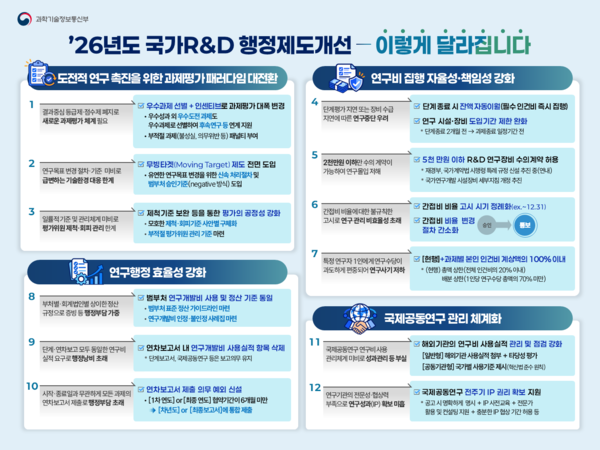
The government will change the evaluation system for national research and development (R&D) projects to focus on challenge-driven outcomes. It will also fully introduce the “Moving Target” system from next year, allowing goals to be changed during research.
The Ministry of Science and ICT said on Sunday it established the “2026 National R&D Administrative System Improvement Plan” and notified related ministries, including the Ministry of Trade, Industry and Energy, the Ministry of SMEs and Startups, and the Ministry of Climate, Energy and Environment.
The plan was drawn up based on 349 opinions collected through an online channel and on-site meetings. It went through deliberation and approval at the 8th National Science and Technology Advisory Council’s deliberation meeting on Aug. 26.
The key is an overhaul of how R&D projects are evaluated. The government abolished the results-based grading and scoring system in July and will establish a new project evaluation system by October.
Under the new system, “excellent outcome projects” with large academic, technological and industrial spillover effects will be recognised as excellent projects. It will also select as excellent projects “excellent challenge projects” that create valuable data and knowledge through trial and error even if they do not reach their original innovative goals. Selected projects will receive incentives such as links to follow-up research and government awards.
Projects with problems during execution, such as legal violations, failure to fulfil agreement obligations or research misconduct, will be classified as “inappropriate projects”. They will face sanctions including recovery of research funds and participation restrictions.
The Moving Target system, which allows researchers to change goals during research, will be fully implemented from next year. Procedures will be shortened so research goals can be changed quickly in line with changes in the technological environment. The government plans to prepare cross-ministry guidelines in a negative-list format to determine whether approvals can be granted.
Rules on the execution of research funds will also be eased. Research facilities and equipment currently must be introduced by two months before the end of a phase. The standard will be changed so they can be introduced up to a certain period before the end of the entire project. When the start of the next phase is delayed after a phase ends, remaining direct costs will be carried over automatically, and necessary labour costs will be allowed even before phase evaluation results are finalised.
A new personal cap will be introduced for research allowances. Currently, total research allowances can be paid within 20 percent of labour costs, and within 70 percent of the total research allowance amount to a single researcher. In addition, the amount an individual can receive will be limited to within 100 percent of that person’s recognised labour cost amount per project.
Settlement standards for research funds, which differed by ministry and accounting firm, will be standardised. The ministry plans to produce and distribute a cross-ministry standard settlement guide and a casebook of recognised and unrecognised research fund items. It will also reduce the burden of submitting annual reports. If the contract period for the first year or final year is less than six months, report content for that year can be integrated into the next year’s annual report and handled together.
It will strengthen management and inspections of how research funds remitted to overseas institutions are used. It will also prepare support measures across the full R&D cycle to protect rights to research outcomes, including intellectual property, of domestic research institutions when signing agreements with overseas institutions.
The ministry plans to begin revising related laws and rules, including the enforcement decree of the R&D Innovation Act, from next month. It aims to fully implement the improved system from 2027.
Park In-kyu (박인규), head of the Science and Technology Innovation Office, said it is essential to create an autonomous research environment where researchers can focus on bold and challenging work. He said the government would break unnecessary practices and build a support system that can be felt in the field.
 Jin-ho Lee
jhlee26@d-today.co.kr
Jin-ho Lee
jhlee26@d-today.co.kr