
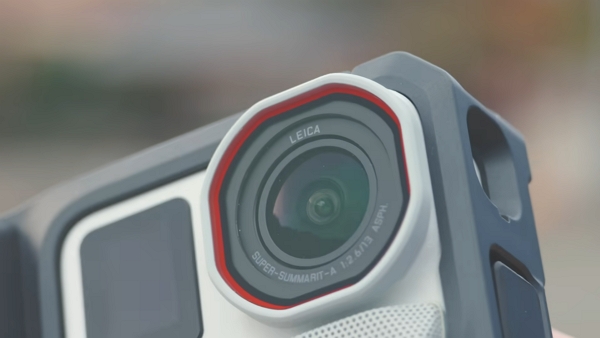
Chinese companies are emerging as new variables in the mirrorless camera market long dominated by Japanese makers such as Canon, Sony and Nikon. That follows Insta360 formalising development of its own mirrorless camera, and speculation that lens maker Viltrox could move into camera bodies.
TechRadar reported on Aug. 30 that most major digital camera brands are currently Japanese companies. Canon, Sony and Nikon, along with Fujifilm, Panasonic, OM System, Sigma, Ricoh and others, are leading the market. In China, DJI has grown its influence in drones and action cameras, and Insta360 in 360-degree cameras, but interchangeable-lens cameras remain centered on Japanese makers.
The most concrete move has come from Insta360. Jingkang JK Liu (징캉 JK 류), chief executive officer of Insta360, said it is currently developing 2 mirrorless cameras. One product will take a form that is hard to find in existing cameras, and Liu said it has the potential to completely change how people take photos. The other product is being discussed as possibly a compact Micro Four Thirds body based on leaked information. Insta360 also hinted it could show a prototype as early as CP+ 2027.
Viltrox is also drawing attention. The company has supplied lenses for Sony E, Nikon Z and Fujifilm X, and joined the L-Mount Alliance last year. It has quickly built its presence with a strategy of offering high optical performance at relatively low prices.
Recently, reports that 2 APS-C-format L-mount prime lenses are being prepared have added weight to speculation it is developing its own camera body. With virtually no new APS-C L-mount cameras currently on sale, some interpret that it could later be linked to an in-house body. Viltrox has not officially announced a mirrorless camera launch, and for now it remains industry speculation.
The competitive landscape is also changing. In Nikkei's tally of 2025 shipments of digital cameras by Japanese companies, Canon kept the top spot with 45.7 percent and Sony stayed second with 24.6 percent, while Fujifilm rose to third at 11.8 percent, overtaking Nikon.
If Chinese companies actually enter the market, the focus of competition could expand beyond image quality and performance to include price and new form factors. In particular, how Insta360 applies the technology it has built in action cameras and 360-degree cameras to mirrorless models is expected to be a key variable in differentiating it from established Japanese makers.
 Choi Jae-won
ittt_0801@d-today.co.kr
Choi Jae-won
ittt_0801@d-today.co.kr