
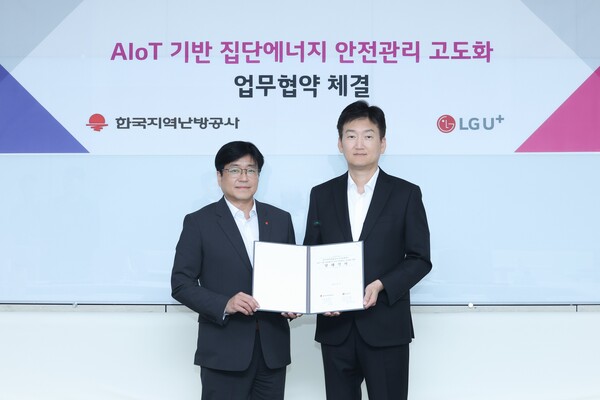
LG Uplus will work with Korea District Heating Corp to upgrade safety management systems at district energy facilities using AIoT technology that combines AI and the Internet of Things (IoT).
LG Uplus and Korea District Heating Corp said on Aug. 31 they signed an MOU on advancing safety management in the district energy sector based on AIoT at LG Uplus' Yongsan office building in Seoul.
The companies will build a predictive maintenance system that detects risk factors at district energy facilities in real time and forecasts and responds in advance to potential accidents using AIoT technology. They will combine LG Uplus' AI-based monitoring and control platform and IoT communications technology with Korea District Heating Corp's operating experience in district energy facilities.
District energy refers to an energy system that supplies heat and electricity produced at large-scale energy production facilities to apartment complexes and office and commercial facilities. District energy facilities, however, can lead to safety accidents if ground subsidence or pipe corrosion occurs, because heat source facilities and heat transport pipes operate in high-temperature environments and the pipes are buried underground.
The companies will test technologies including early detection of ground subsidence, detection of stray current in heat transport pipes, and stronger physical security and monitoring at high-risk facilities such as electrical receiving and distribution rooms.
To detect ground subsidence, they will use tilt-sensing technology in an underground geothermal remote-sensing terminal jointly developed by the two companies. Sensors will track in real time changes in tilt and vibration intensity at sites where heat transport pipes are buried, and AI will analyse ground changes.
They will also monitor in real time stray current that can cause corrosion of heat transport pipes. By analysing current density and frequency flowing through pipes, they will identify corrosion risk points early. They will review steps to automate work to divert stray current to a safe location in the future.
The companies will apply AI-based physical security technology to electrical receiving and distribution rooms, where there is a risk of electric shocks and entrapment accidents. They will monitor them around the clock through an integrated control platform and strengthen access control to key equipment such as doors, enclosures and server racks, along with managing work histories.
The companies previously jointly developed South Korea's first IoT temperature sensor in 2020. Last year, they completed field testing of a miniaturised IoT monitoring device designed for underground installation. They plan to use this agreement to apply AI-based risk forecasting technology to existing safety management systems.
Kwon Yong-hyun (권용현), head of the enterprise division at LG Uplus and a vice president, said, "We will closely examine blind spots in safety at district energy facilities and continue to advance AIoT solutions to contribute to strengthening safety in energy infrastructure."
Jeong Nam-seong (정남성), head of the construction division at Korea District Heating Corp, said, "This agreement is meaningful in that it expanded the application of AIoT technology beyond heat transport pipes to heat source facilities." He added, "We will strengthen cooperation with LG Uplus to complete an intelligent prevention system for district energy facilities."
 Jin-ho Lee
jhlee26@d-today.co.kr
Jin-ho Lee
jhlee26@d-today.co.kr