
In last year’s telecom service quality assessment, 79 of 87 areas and facilities found to have inadequate quality improved. Eight subway sections, however, still fell short of the standard.
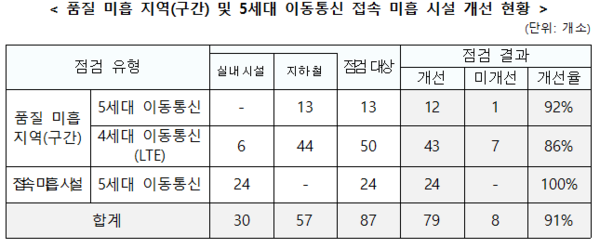
The Ministry of Science and ICT and the National Information Society Agency (NIA) said on Saturday that a reinspection of 87 sites found to have slow transmission speeds or weak signal strength in the 2025 telecom service quality assessment showed quality had improved at 79 sites.
The improvement rate was 91 percent. The reinspection covered indoor facilities and areas and facilities with poor subway quality. Poor-quality sections on high-speed rail lines, where investment in Shared Network 2.0 equipment is under way, will be inspected separately at the end of this year.
All 30 indoor sites improved, including 24 facilities with inadequate 5G access and 6 areas with poor LTE quality.
Average download speeds at indoor facilities with poor LTE quality rose 196 percent to 99.34 Mbps from 33.61 Mbps. By carrier, SK Telecom improved to 111.82 Mbps from 49.62 Mbps, and LG Uplus improved to 93.09 Mbps from 25.61 Mbps.
Some poor sections remained on subways. For 5G, 12 of 13 poor sections improved, for an improvement rate of 92 percent. All 9 sections operated as single-carrier networks improved, but 1 of 4 shared-network sections did not improve.
The unimproved 5G section was the Seonghwan-Jiksan section of Seoul Metropolitan Subway Line 1. In a shared 5G area provided by SKT, KT’s service quality was found to be inadequate.
Average subway 5G download speeds rose 87 percent to 661.54 Mbps from 354.34 Mbps. SK Telecom improved to 817.12 Mbps from 377.81 Mbps, KT to 588.86 Mbps from 344.24 Mbps, and LG Uplus to 285.50 Mbps from 230.33 Mbps.
For LTE, 37 of 44 subway sections with poor quality improved, while 7 sections remained inadequate. The improvement rate was 84 percent.
Unimproved sections for SKT were the Myeongnyun-Oncheonjang section on Busan Line 1, the Gangseogu Office-Sports Park section on Busan Line 3, and the Gwaebeop Renecite-Sasang section on the Busan-Gimhae Light Rail Transit. For KT, they were the Seryu-Byeongjeom and Seonghwan-Jiksan sections on Seoul Metropolitan Subway Line 1, the Oido-Dalwol section on the Suin-Bundang Line, and the Buram-Daesah section on the Busan-Gimhae Light Rail Transit. LG Uplus had no unimproved sections.
Average subway LTE download speeds rose 125 percent to 118.98 Mbps from 52.84 Mbps. By carrier, the improvement rates were 131 percent for SK Telecom, 117 percent for KT and 59 percent for LG Uplus.
The ministry and the three mobile carriers are also pushing work to improve quality on high-speed rail lines. On the Gyeongbu and Honam lines, key sections with high passenger use, including Pyeongtaek Jije-Daejeon, Daejeon-Miryang, Dongdaegu-Ulsan, Osong-Iksan and Iksan-Jeonju, are to complete equipment interconnection among the three mobile carriers before the Chuseok holiday.
Construction of Shared Network 2.0 on the remaining sections of the Gyeongbu and Honam lines is to be completed by the end of this year. The government aims to improve telecom quality on all routes and sections of high-speed rail lines by 2027.
The ministry said it will reinspect the 8 subway sections that remain unimproved, as well as high-speed rail sections such as the Gyeongbu and Honam lines, in the second half’s telecom service quality assessment. It will also seek to encourage investment by mobile carriers through continued quality assessments and reinspections of poor areas.
 Jin-ho Lee
jhlee26@d-today.co.kr
Jin-ho Lee
jhlee26@d-today.co.kr