
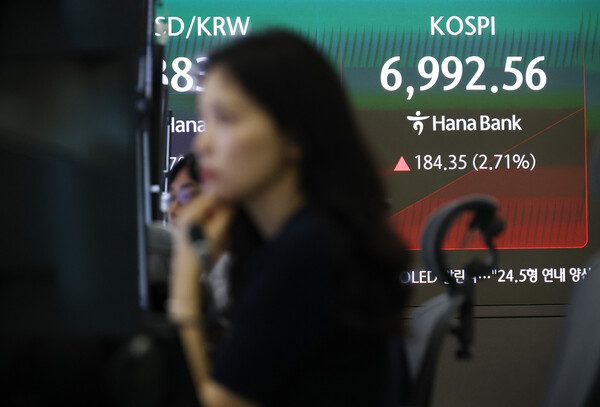
Investor deposits, cash waiting on the stock market, fall below 100 trillion won in two weeks, while credit trading balances rise again into the 33 trillion won range. With the KOSPI repeatedly rising and falling ahead of 7,000, individual investors appear to have less cash while borrowing for investment increases.
The Korea Financial Investment Association said on Aug. 27 that investor deposits stood at 98.9 trillion won as of Aug. 26, down 3.6 trillion won from the previous session.
Investor deposits drop below 100 trillion won for the first time in about two weeks since Aug. 12, when they recorded 100.0 trillion won. Deposits increase to 106.6 trillion won on Aug. 19 before resuming a decline.
By contrast, credit trading balances, a measure of so-called leveraged stock investing using borrowed money, increase.
As of Aug. 26, credit trading balances total 33.1 trillion won, up 254.0 billion won from the previous session. They rise back into the 33 trillion won range for the first time in about a month since 33.2 trillion won on July 28.
Credit trading balances fall to 27.4 trillion won on Aug. 4, but rise for seven consecutive sessions from Aug. 18. That is an increase of about 5.7 trillion won in just over three weeks.
Unsettled trades, which have the nature of ultra-short-term credit transactions, also increase. The balance of unsettled trades is 1.1 trillion won, up 146.9 billion won from the previous session.
Forced liquidation by brokerages, in which shares are sold because unsettled amounts are not repaid, is tallied at 12.7 billion won. Forced liquidation accounts for 1.3 percent of unsettled amounts.
The market is paying attention to investor deposits falling while credit trading increases at the same time. Cash-like funds that investors can immediately use to buy shares are shrinking, while the scale of leveraged investment is growing.
As the KOSPI recently tries to break above 7,000 but fails to settle there and shows volatility, individual investors' credit trading is interpreted as increasing again on expectations of further gains.
In particular, with credit trading balances rising rapidly in a short period, there are suggestions that related indicators need to be watched because if stock market volatility expands it could lead to more forced liquidation.
 Sangyeop Oh
yub@d-today.co.kr
Sangyeop Oh
yub@d-today.co.kr