
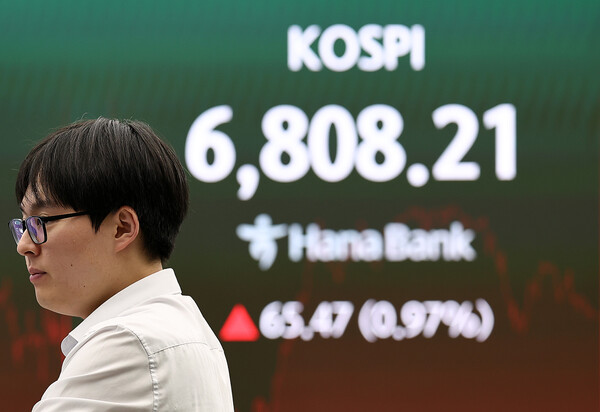
South Korea's KOSPI rose for a second straight day, helped by institutional buying and a rebound in large semiconductor blue chips, to regain the 6,800 level. The Kosdaq, however, ended slightly lower after swinging between gains and losses during the session.
On Aug. 26, the KOSPI ended up 65.47 points, or 0.97 percent, at 6,808.21. The index opened down 15.49 points, or 0.23 percent, at 6,727.25, then climbed as high as 6,887.18, nearing the 6,900 level, before giving back part of its gains.
In the main board market, institutions led the rise with net purchases of 760.4 billion won. Retail investors were net sellers of 2.24 trillion won, and foreigners sold 116.2 billion won net.
After semiconductor stocks rebounded in the U.S. market a day earlier, large domestic chipmakers also showed strength. Samsung Electronics closed up 1.75 percent at 261,500 won and SK Hynix ended 0.60 percent higher at 1,688,000 won.
Samsung Life rose 8.60 percent, Samsung C&T added 5.59 percent, Samsung Biologics gained 0.88 percent and LG Energy Solution was up 0.43 percent.
Hyundai Motor fell 3.09 percent to 408,000 won, while Samsung Electro-Mechanics lost 2.35 percent to 1,330,000 won. SK Square also slipped 0.19 percent.
The Kosdaq ended down 0.28 points, or 0.03 percent, at 826.87. It fell below the 820 level early in the session and recovered most of the loss, but failed to turn higher.
In Seoul's foreign exchange market, the won was 1.80 won weaker at 1,385.30 per dollar.
South Korean stocks have shown increased volatility in large-cap semiconductor shares since Samsung Electronics announced shareholder returns on Aug. 24, but have been recovering losses on bargain hunting and sector rotation.
Han Ji-young (한지영), an analyst at Kiwoom Securities, said strategies such as excessively cutting exposure to semiconductors, which are facing controversy over weakening market leadership, or selling into rebounds to raise cash should be treated as lower priority. Maintaining existing leaders at their market-cap weight while buying in tranches other key sectors such as retail, securities, power equipment and biotech on further pullbacks in non-semiconductor areas is an alternative strategy, Han said.
 Sangyeop Oh
yub@d-today.co.kr
Sangyeop Oh
yub@d-today.co.kr