
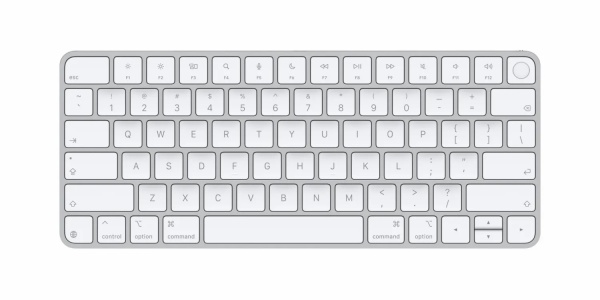
Apple has removed text markings from some keys on its new Magic Keyboard and switched to icon-centred labels. It extends keyboard design changes applied earlier this year to the MacBook lineup to desktop peripherals, focusing on visual consistency without major changes to hardware functions or layout.
On Aug. 25, local time, IT outlet 9to5Mac reported that Apple introduced a new Magic Keyboard lineup alongside the new Mac mini and Mac Studio unveiled that day.
The most noticeable change is the characters shown on keycaps. Apple removed text labels and left only icons on keys that had been marked with words, including Tab, Caps Lock, Return, Shift and Delete. On the extended model that includes a numeric keypad, the Home, Page Up and Page Down keys were also changed to new icons.
Apple explained the change by saying it removed text labels from several keys and converted them into glyphs. The change is not limited to a specific model. The same design is applied across the entire new Magic Keyboard lineup, from the base model to versions with Touch ID and those offering both Touch ID and a numeric keypad.
Prices vary by model as before. The base Magic Keyboard costs $99, the Touch ID model $149, and the model with Touch ID and a numeric keypad $179.
The new Magic Keyboard changes how keys are marked, but functions and key layout do not differ significantly from the previous generation. It supports USB-C and keeps the same functions and layout as the existing model. The update therefore focuses on refining the keyboard's appearance rather than adding new features.
Apple previously applied a similar change to the MacBook Neo, MacBook Air and MacBook Pro released earlier this year. It introduced an approach that uses icons instead of text on major function keys and some other keys, and expanded that design to desktop peripherals through the Magic Keyboard revamp.
Apple's shift in key markings is seen as a move to unify design language across its product lineup. By using a similar icon system across laptops, desktops and peripherals, it aims to improve visual consistency across Apple products.
The change also ties in with the desktop products unveiled on the same day. The new Mac mini and Mac Studio feature the next-generation M6 and the high-end M5 Ultra, strengthening performance. While the main units focus on performance gains through new chips, the peripherals refine the product experience by adjusting the key marking system.
Still, the actual user experience is unlikely to change much. Key functions and layout are the same as before. The core change in the Magic Keyboard is not a sweeping hardware overhaul but a small design shift from text labels to icons.
With Apple switching to icon-centred markings from laptops to the Magic Keyboard, attention is turning to whether the same design language will extend to other input devices and how quickly users will adapt to a key layout marked only with icons and no text.
 Jinju Hong
hongjj@d-today.co.kr
Jinju Hong
hongjj@d-today.co.kr