
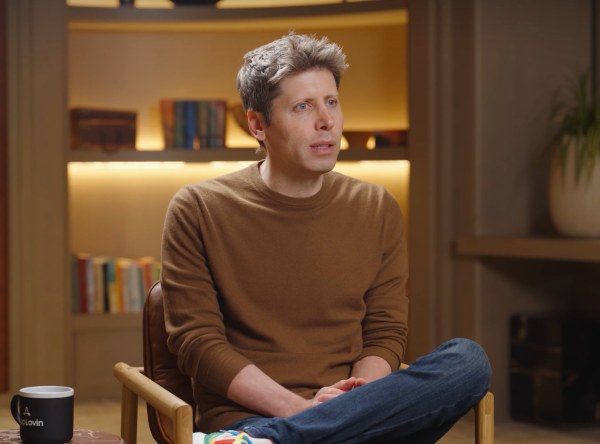
Sam Altman (샘 알트먼), chief executive of OpenAI, said artificial intelligence has not yet reached an “iPhone moment” that changes the mass consumer market.
On Aug. 25 (local time), IT outlet 9to5Mac reported Altman said on a recent podcast that today’s AI industry is at a stage similar to the smartphone market before the iPhone launched.
Altman made the remarks in a podcast hosted by David Senra (데이비드 센라). He pointed to a time when the industry had already used Windows CE, Nokia and Palm OS devices, saying smartphones before the iPhone were closer to a “computer in your pocket” for a limited set of users. He said AI is in a similar situation now and assessed that AI companies, including OpenAI, have not yet found a formula to bring the technology into everyday consumer life in earnest.
The remarks reflect a view that, even as AI competition is rapidly unfolding around model performance and enterprise adoption, a decisive turning point has not yet arrived in mass-market services. Altman suggested that the next stage for AI depends not on simple performance improvements but on product experiences that make general users use it naturally.
Altman directly mentioned Apple’s product strategy in this process. He recalled Apple co-founder Steve Jobs (스티브 잡스) stressing that saying “no” to many good ideas makes it possible to focus on a small number of important products, and he acknowledged he was not good at sorting good ideas to protect bigger ideas. It underscores that AI companies, where product and research tasks expand at the same time, cannot easily avoid the problem of choosing what to focus on.
Existing views on the pace at which AI will shake the economy were also adjusted in part. Altman acknowledged he had overly high expectations about how quickly AI would upend the economy. Still, he maintained his outlook that the spread of AI would create new business opportunities. He said in particular that there could be the “biggest boom in small businesses that people start” in the future.
He cited two reasons. One is that AI makes it possible to start and run a business with fewer resources. The other is a spillover effect in areas that keep their distance from AI. Altman said some businesses could succeed precisely “because they have nothing to do with AI,” and predicted people may come to want “authentic and non-technical experiences.”
The remarks differ from forecasts that AI will replace or absorb all industries in the same way. They suggest that as the number of companies using AI grows, businesses that emphasize non-technical experiences and human touchpoints can also gain demand. As a result, competition in the AI market is increasingly likely to be shaped not only by model performance but also by consumer touchpoints, product simplification and business planning that does not put technology front and center.
Ultimately, Altman’s message can be read in two directions. The AI industry has not yet created a signature product that changes the mass market, and in that process the ability to decide what to discard is important, more than adding more functions. He also offered a view that AI’s economic impact may be more gradual than expected, but business opportunities themselves could spread in an even broader form.
My conversation with Sam Altman (@sama), co-founder & CEO of @OpenAI. 0:00 Tobi Lütke, AI-Native Companies & Why Adoption Moves Slowly 5:45 Sam's Own Resistance to AI & the Missing iPhone Moment 10:00 Models, Compute, Power Laws & Non-Consensus Talent 18:37 From AI-Obsessed Kid… pic.twitter.com/IOlRGD94T6
 Seung-a Yoo
ysah@d-today.co.kr
Seung-a Yoo
ysah@d-today.co.kr