
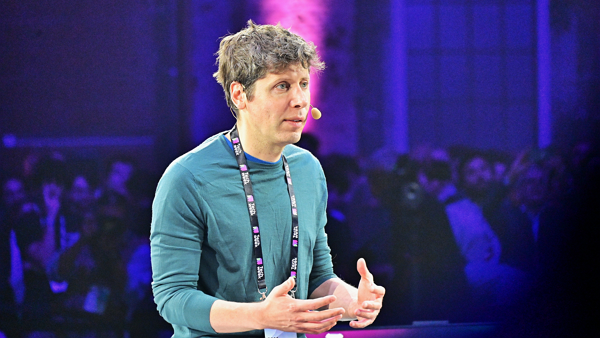
Sam Altman (샘 알트먼), CEO of OpenAI, said he still personally handles repetitive tasks such as sorting email that artificial intelligence can process faster.
On Aug. 24 local time, Business Insider reported that Altman appeared on David Senra's podcast and said he goes through his email one by one even though he could use Codex.
He said people should not work by blankly scanning their inbox and picking the message that feels least burdensome to answer right away. He explained that repetitive tasks such as moving information between apps or working through a to-do list should be actively handed over to AI.
Altman also said it is not easy to break the habit of handling repetitive work personally. "The idea is etched into my head that doing this kind of thing is work and productivity," he said. He meant that familiar ways of working can weigh more heavily than efficiency.
Altman acknowledged that such behavior is psychologically contradictory. "I can't say I like working this way," he said, adding, "It doesn't make sense, but it feels kind of good." He said that as better products emerge, the shift to an AI-centered way of working will become more natural.
The remarks show that, apart from the performance of AI tools, users' habits are an important variable in workplace shifts. Even if email sorting or drafting replies can be automated, many users are still in a transitional period in which they continue to use their existing computer workflow alongside AI tools.
Altman described this by saying, "People are in two worlds right now." He meant that people keep the familiar method of sorting email themselves while also testing AI that can do the same work.
In corporate workplaces, efforts to reduce email-centered work are continuing. Andrew Bialecki, CEO of Klaviyo, said in an interview last March that he recently built a script himself that organizes and delivers key information from the past 24 hours. Roland Busch, CEO of Siemens, said he receives 200 emails a day but keeps the remaining number below 100, and uses dictation while walking around the office when he needs to provide specific replies.
Ultimately, what determines the spread of AI at work is not only the technology's performance but also how quickly users can change their familiar ways. Altman's case shows that even if AI adoption speeds up, change in actual work culture may not keep pace.
 Yoonseo Lee
yslee@d-today.co.kr
Yoonseo Lee
yslee@d-today.co.kr