
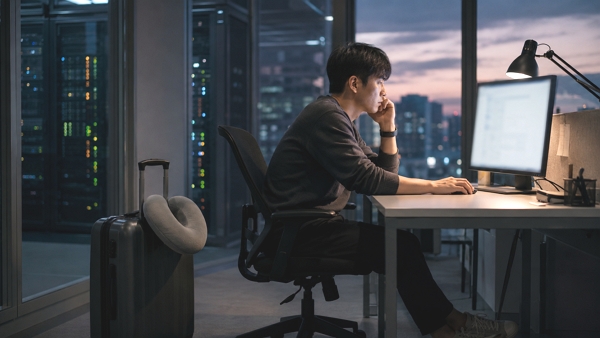
As competition for AI leadership intensifies, a debate has emerged in Silicon Valley over whether employees can properly take vacations. Rapid technological change is combining with long-hour work culture, adding to the burden of potentially falling behind while taking time off.
According to the IT outlet Business Insider on Aug. 24, the debate began after Miles Brundage, who previously led policy research at OpenAI, posted on X to the effect that some AI labs seem more proactive about vacations than others.
The post then drew reactions from OpenAI and Anthropic employees. One Anthropic employee said, "I took 2 weeks off at the Edinburgh Fringe Festival in the UK," and an OpenAI employee replied, "Seems like a sign I should take a vacation too." OpenAI researcher Leo Gao (레오 가오) wrote, "My work tended to consume my entire life," adding, "In that sense OpenAI was a good fit." Other employees also traded jokes about how often they take vacations.
The debate spread to other AI organisations, including Google DeepMind. Alex Imas, head of AGI economics who recently moved from academia to DeepMind, also joked that he was "still learning the concept of vacation." Brundage explained, "The main reason I raised this topic was, ultimately, to stress that rest is important."
A lack of vacation in the system is not the issue. According to the U.S. Bureau of Labor Statistics, 95 percent of information industry workers received paid leave in 2025. A 2025 tech industry benefits survey by Alliant, cited by the outlet, showed companies offered an average of 19.8 days of paid time off. The question is whether employees have the psychological room to actually use leave even when it exists.
In the AI industry, complaints are emerging that keeping up with technology trends has itself become part of the job as models and products pour out quickly. One industry worker compared it to drinking water from a hose that keeps getting thicker. Some technology companies have also seen the emergence of a high-intensity "996" work culture, referring to working from 9 a.m. to 9 p.m., 6 days a week. Sam Altman, OpenAI's chief executive, also described the industry's 분위기 in 2018 as "not a good example in terms of work-life balance."
The faster AI competition becomes, the more creating a culture of rest that enables employees to keep working, as well as competing to secure talent, appears to be emerging as a task for AI companies.
 Choi Jae-won
ittt_0801@d-today.co.kr
Choi Jae-won
ittt_0801@d-today.co.kr