
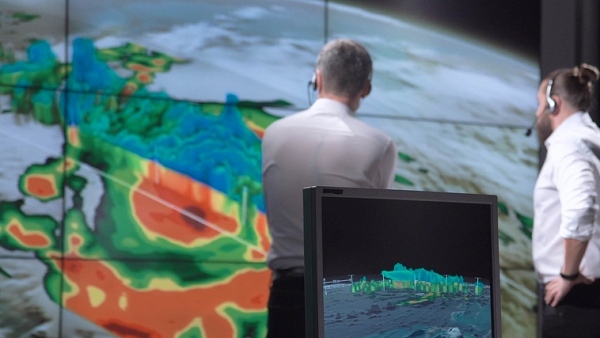
AI is dramatically boosting the speed of weather forecasts, but accuracy is not determined by model performance alone. An analysis says quickly and accurately assessing current atmospheric conditions remains key.
On Aug. 24, Alexander Matveenko (알렉산더 마트베옌코), CEO of Rainbow AI, stressed in a contribution posted on the IT outlet TechRadar that "the starting point of weather forecasting is the current state of the atmosphere". Information collected from radar, satellites, ground observation stations, weather balloons and aircraft varies in resolution, refresh cycles and errors. The process of combining this with existing forecasts to estimate current conditions is data assimilation. If the initial analysis is inaccurate or outdated, even an excellent model struggles to produce an accurate forecast.
Thunderstorms that form and develop within a short period are particularly difficult to predict. A method that calculates the direction of precipitation movement from existing radar screens may not fully reflect changes in which rain clouds suddenly form, split or merge. Even within the same city, rainfall and winds can vary sharply by area, worsening problems for industries that need fine-grained weather information such as drones, airports, solar power generation and logistics.
The World Meteorological Organization defines detailed local forecasts from now to 6 hours ahead as nowcasting. In this process, the ability to continuously receive observation data and update forecasts within minutes is important.
AI can produce forecasts much faster and with less computing. The European Centre for Medium-Range Weather Forecasts' AI forecasting system, AIFS, also shows better performance than existing physical models across several indicators, but its starting point is still an analysis that combines tens of millions of observations. That is why ECMWF operates AIFS alongside the physics-based IFS.
In the AI era, the key to accurate weather forecasts lies not only in smarter models but also in how quickly more up-to-date and accurate observation data can be secured.
 Jae-won Choi
ittt_0801@d-today.co.kr
Jae-won Choi
ittt_0801@d-today.co.kr