
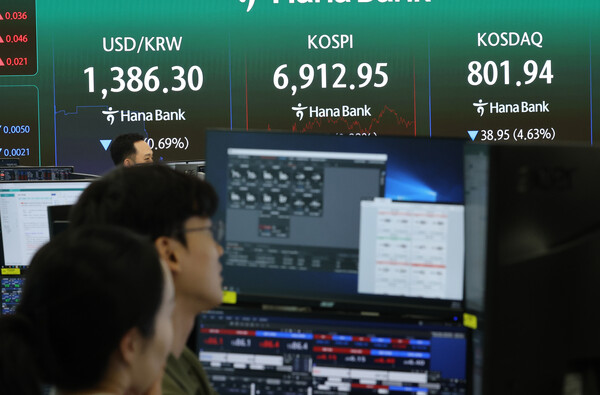
South Korean stocks are expected to seek direction this week as they check Nvidia earnings and the U.S. July personal consumption expenditures (PCE) price index. Expectations for semiconductor results and large-scale shareholder returns are supporting the downside, while U.S. long-term yields and Middle East instability remain variables.
The KOSPI closed on Aug. 21 up 60.37 points, or 0.88 percent, at 6,912.95. The Kosdaq, however, plunged 4.63 percent to end at 801.94. With the burden of rising U.S. Treasury yields weighing more heavily on growth and small-cap stocks, the two markets moved in opposite directions.
U.S. stocks rebounded in the latest session. On Aug. 21, the Dow Jones Industrial Average rose 0.98 percent to 53,277.01, the S&P 500 gained 0.43 percent to 7,674.37 and the Nasdaq climbed 0.43 percent to 26,180.45. On the week, however, the S&P 500 fell 1.4 percent and the Nasdaq dropped 2.1 percent, extending caution over higher long-term yields.
In South Korea, semiconductors remain at the center of the index. Stock volatility has increased recently on worries about higher long-term yields and the cost burden of artificial intelligence (AI) investment, but an assessment is emerging that semiconductor profit forecasts themselves have not been significantly damaged. Spot DRAM prices are holding at elevated levels, and memory demand tied to AI data center investment is continuing.
Large-scale shareholder returns have also emerged as a new support for supply and demand. SK Hynix decided on Aug. 19 to buy back about 40 trillion won worth of its own shares from Aug. 20 to Nov. 19 and cancel all of them. The target is about 24.07 million shares, or 3.3 percent of outstanding shares. It also expanded its 2025 to 2027 cumulative free cash flow (FCF) shareholder return standard to "at least 50 percent" from "within a 50 percent range."
Samsung Electronics also held a board meeting on Aug. 21 and approved a plan to implement shareholder returns estimated at about 90 trillion to 110 trillion won this year. Starting with 30 trillion won in dividends in the third quarter, it plans to decide on additional cash dividends and share buybacks and cancellations. That means profit growth and shareholder returns are strengthening at the same time, centered on large domestic semiconductor stocks.
The industry sees expanded shareholder returns as potentially affecting a re-rating of South Korea's stock market valuation beyond near-term buying flows. When a company buys back and cancels shares, the number of shares in circulation falls and earnings per share (EPS) can rise. Continued cash returns can also translate into improved return on equity (ROE).
In particular, the KOSPI has recently been in a state where stock prices have fallen sharply relative to earnings forecasts. The KOSPI's 12-month forward EPS stands at 1,225.9 points, remaining above 1,105.1 points at the end of June, but the forward price-to-earnings ratio (PER) is staying in the 5-times range.
If earnings growth is maintained and shareholder returns expand, expectations could rise again that undervaluation will ease, led by large-cap stocks.
The first hurdle this week is Nvidia earnings. Nvidia will release second-quarter results on Aug. 26 local time. In South Korea, the results can be checked early on Aug. 27. The market is expected to look not only at the results themselves but also next-quarter guidance and how strongly AI data center investment demand is holding up.
The biggest recent concern about AI investment is whether big tech can secure actual profitability even as it pours in massive funds. Nvidia is a direct beneficiary of the AI investment cycle, so if sales and profit growth continue and demand for next-generation products is also confirmed, it is likely to have a positive impact on domestic semiconductor investment sentiment.
Conversely, even if results beat market expectations, if the outlook falls short of expectations, the pattern seen repeatedly in recent months of "profit-taking after strong results" could emerge. In the U.S. stock market, cases of increased share-price volatility after earnings announcements have continued due to raised expectations, and domestic semiconductor stocks could also be affected.
The U.S. July PCE price index, released on the night of Aug. 26, is also a key variable. The U.S. Bureau of Economic Analysis (BEA) will publish July personal income and consumer spending statistics at 8:30 a.m. local time on Aug. 26. The core PCE price index rose 3.3 percent year-on-year in June.
The industry sees a possibility that the July PCE and core PCE inflation rates could come in around 3.6 percent and 3.3 percent, respectively. If inflation pressures ease, the rise in U.S. Treasury yields could cool, which could have a positive impact on South Korean stocks.
If inflation comes in higher than expected, compounded by the impact of higher international oil prices, worries about additional tightening could grow again.
The Jackson Hole symposium, held Aug. 27 to 29, also needs attention. With U.S. long-term Treasury yields surging recently, the burden of financing costs for large-scale investment projects such as AI data centers has increased.
Depending on what message the Federal Reserve delivers on the future rate path, investment sentiment in tech and semiconductors could be shaken again.
Middle East conditions and international oil prices are also variables. Oil prices are rising again as conflict between the United States and Iran continues, which could spur both inflation and U.S. Treasury yields.
With markets recently reacting more sensitively to interest-rate changes than to corporate results, short-term volatility could increase if geopolitical uncertainty expands.
The Kosdaq is expected to show higher volatility than the KOSPI for the time being. While large semiconductor stocks have gained relatively clear upward drivers in earnings and shareholder returns, the Kosdaq is in a situation where results differentiation is large by stock. An assessment is emerging that investors need to focus on stocks with improving earnings outlooks rather than simple oversold moves or themes.
Ultimately, the key for South Korean stocks this week is how much semiconductor companies' earnings and shareholder returns can offset the burden of U.S. rates.
If Nvidia confirms the durability of the AI investment cycle and the PCE does not add to inflation concerns, the KOSPI could try again to break above 7,000.
If AI investment expectations weaken or U.S. long-term yields surge again, volatility could persist in both the KOSPI and the Kosdaq.
Lee Jae-won (이재원), a researcher at Yuanta Securities, said share buybacks and cancellations are not simply a short-term supply-and-demand event. He said if capital efficiency rises through repeated share buybacks, expanded shareholder returns could also be seen as a factor for valuation re-rating and easing the Korea discount.
Lee Kyung-min (이경민), a researcher at Daishin Securities, said trust in improving semiconductor results is continuing despite persistent uncertainty in the external environment. He said he expects valuation normalization based on improved results and a rebound trend in the index to continue.
 Sangyeob Oh
yub@d-today.co.kr
Sangyeob Oh
yub@d-today.co.kr