
As AI expands beyond simple Q&A to the stage of performing real work, use cases are increasing in knowledge work such as research and reporting.
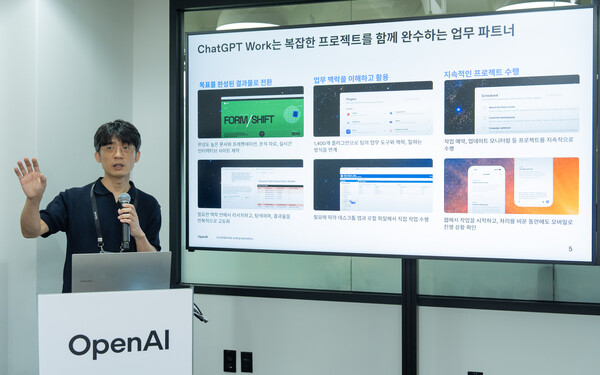
OpenAI on Wednesday held a "ChatGPT Work media demo" at the OpenAI Korea office in Seoul's Gangnam district and introduced major ChatGPT Work functions and real-world use cases. The event shared in detail how journalists and researchers are integrating Codex into their existing work.
Lee Kyung-hee (이경희), deputy head of the Content 1 bureau at JoongAng Ilbo, shared her experience of using Codex to change a labor-intensive content production process.
Lee used Codex to produce PDF books for paid subscribers. Previously, articles and photos were gathered again to make a materials book, and content updates, design and typesetting, and proofreading took 2 to 3 months.
To produce usable results, Lee carried out what she called "skill refining." She said the early Codex output was "2,000 percent insufficient" to distribute as a paid service. Because it was not easy to find design skills suited to publications, she ultimately brought in a designer and made fine adjustments from font size and margins to image placement and page composition.
She also broke down the production process in more detail. She had Codex extract and organize text, photos and graphics from articles and edit them into a pre-set format. Design rules revised by the designer were reflected back into the skills. At the proofreading stage, she had Codex create a QA sheet, and when people wrote down errors and revisions, she had them reflected again.
Work that used to take 2 to 3 months was sharply reduced. At first, she expected it would be possible to publish about once a month, but she is now putting out the materials book about once a week. The volume published over the past two months is comparable to what came out over the previous three years, she added.
Lee said what knowledge workers need in the AI era is discernment. "You should not accept as-is the distinctive texture of AI-generated writing or design, and you need to be able to fix it and say, 'this isn't it,'" she said. "In the end, you need to have high standards, and you need experience in your field and your own individuality," she added.
Ko Gil-gon (고길곤), head of IT services at Seoul National University and a professor at its Graduate School of Public Administration, introduced a case of dividing the process of producing a research report into multiple agents and skills.
Ko said that in a country study project analyzing political, administrative, economic and social structures by country, he configured agents and skills for each task, including data research, statistics and visualization, and source verification. Rather than assigning everything from research design to drafting at once, he split roles by the work needed.
To improve report quality, he also reflected review results in the skills. After having the report written by chapter and section, he checked it himself and reflected errors or areas for improvement in the skills. He said the revised standards were later applied when producing reports on other countries.
"In the past, doing one of these projects cost about 50 million to 100 million won per country," Ko said. "AI is now greatly lowering these costs," he added. Still, he stressed that deciding which indicators to look at, which data to trust and what to treat as the problem remains the researcher's job.
OpenAI also demonstrated ways to use ChatGPT Work tailored to journalists' work.
Shim Dae-yeol (심대열), an engineer at OpenAI Korea, said a big advantage is that even non-developers can make what they need and use it themselves. He said that if published outputs and revisions are continuously reflected, it becomes possible to create an agent that increasingly resembles the user.
The demo introduced how to set reporting beats and article-writing principles as project baseline information in AGENTS.md, along with news briefings and data research and fact-checking, parallel reporting using sub-agents, and saving repetitive tasks as skills for reuse. Complex work is divided among multiple agents, while a journalist reflects edited outputs back to build a personal way of working and judgment criteria.
OpenAI views ChatGPT Work and Codex as "task-completion AI" products. Its strategy is to draw office workers and other general users into the Codex ecosystem, which had been strongly seen as a developer product. According to OpenAI, task-completion AI users, who were about 4 million in April, increased to more than 10 million across Codex and Work after the launch of ChatGPT Work.
Eum Seong-won (음성원), head of communications at OpenAI Korea, said demand is growing among companies for agents that carry out actual work to the end rather than simple Q&A. "As usefulness increases, corporate use is growing, and we see it having a positive impact on revenue," he said.
 Seulgi Son
sageson@d-today.co.kr
Seulgi Son
sageson@d-today.co.kr