
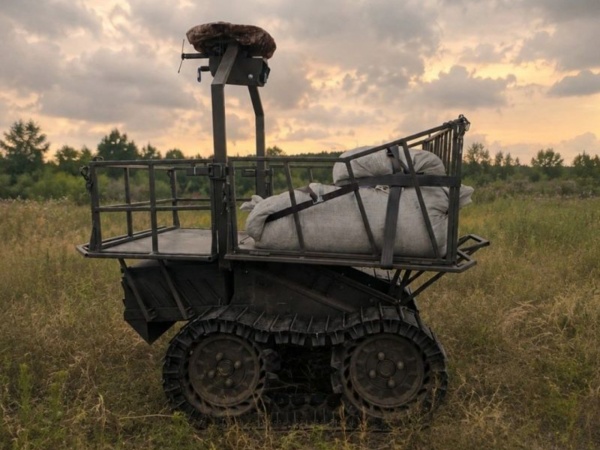
[DigitalToday reporter Jinju Hong] Ukrainian robotics company Temerland unveiled the Gnom L2 unmanned ground vehicle (UGV), which can carry up to 210 kg of cargo and travel across rough terrain. The goal is to reduce troops’ exposure to risk during resupply by moving heavy materials such as ammunition and equipment to forward positions.
On Aug. 19 (local time), IT outlet TechRadar reported that the Gnom L2 is a UGV developed for heavy cargo transport.
The Gnom L2 has a maximum payload of 210 kg and a top speed of 12 km per hour. It has a high-capacity battery designed to travel up to 50 km on a single charge. It also reinforced its cargo basket to transport heavy loads stably.
It uses a structure combining wheels and tracks for mobility. It is designed to carry cargo even over uneven terrain off paved roads. The company introduced the Gnom L2 as a vehicle designed to transport significant weight in difficult terrain.
Despite its name, it is not a fully autonomous robot. An operator must control it remotely using dedicated HotRC equipment, and it does not support autonomous control that lets the vehicle determine its own route. In other words, the Gnom L2 is closer to a remotely operated unmanned resupply vehicle than an AI-based fully autonomous military robot.
The primary purpose of the Gnom L2 is to reduce troop risk during forward resupply. If the robot carries heavy materials such as ammunition or equipment, it can cut the number of times soldiers must travel to and from hazardous areas. Expectations are that replacing repetitive resupply missions with unmanned vehicles could reduce both manpower burden and risk exposure.
There are many variables in an actual operating environment. Real-world range could vary depending on payload and terrain, and it has not yet been confirmed how it could respond if the communications link needed for remote control is severed or if it is exposed to electronic warfare conditions.
The Gnom L2 is currently in the field evaluation stage. As a result, the published specifications could change during future testing, and production scale, price, actual deployment numbers and combat operation results have not been disclosed.
Temerland is also developing other Gnom-series robots for various missions. The reconnaissance Gnom ND-Recon is equipped with 6 cameras and 6 high-sensitivity microphones. It also supports operating a tethered drone together with a charging station, focusing on reconnaissance missions.
A variant model equipped with a robotic arm is also under development. That model aims to carry out casualty evacuation, mine clearance and engineering tasks. The strategy is to broaden use of a single robot platform beyond resupply to missions such as reconnaissance, evacuation and engineering.
Ultimately, the success of the Gnom L2 depends less on its disclosed top speed or payload than on how reliably it can carry out repeated resupply missions in real battlefield conditions. Off-road mobility and communications stability, electronic warfare response capability, battery endurance and mass-production capacity will be subjects for future verification. As it remains in the testing stage, whether it will be deployed in actual combat and at what scale has not been decided.
 Jinju Hong
hongjj@d-today.co.kr
Jinju Hong
hongjj@d-today.co.kr