
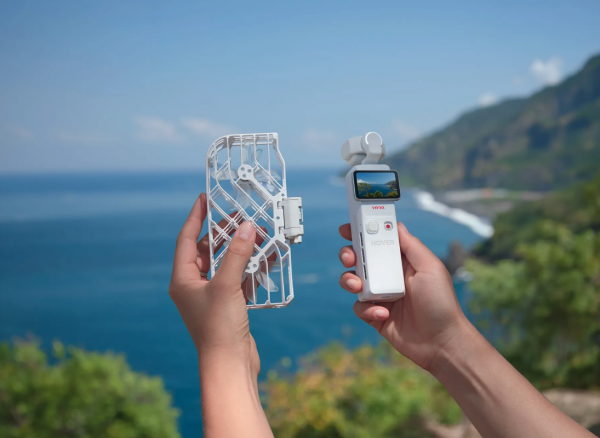
HoverAir has unveiled a new product that combines a self-flying drone and a pocket gimbal camera into one. It is a 2-in-1 product that can film from the sky as a drone, then be used as a portable gimbal camera once the wings are detached.
According to IT outlet TechRadar on Aug. 19 local time, HoverAir has unveiled its new Versa and is preparing to launch it in the U.S. market. Versa has received certification from the U.S. Federal Communications Commission (FCC), making it eligible for sale in the United States.
Versa’s biggest feature is its detachable design. Its appearance is similar to HoverAir’s existing X1 series, but removing the wing section turns the main unit into a pocket gimbal camera. HoverAir is introducing it as the world’s first 2-in-1 pocket gimbal camera and drone.
With the drone and camera combined into a single product, it targets portability and usability at the same time. In drone mode, it films while following a subject in the air. With the wings removed, it can be held in the hand to shoot everyday videos.
HoverAir has previously introduced products including the X1 self-flying drone that can take off directly from the palm, the X1 Pro that supports 8K recording, and the Aqua with enhanced waterproofing. Versa is a model that expands this lineup by one step.
Its video performance also targets the portable camera market. Versa uses a 1/1.3-inch sensor and supports up to 4K 60fps video recording. It can also shoot 4K HDR at 30fps based on 10-bit color depth, offers up to 17.5EV of dynamic range, and can take 12-megapixel photos.
Its flight functions focus on selfies and vlogs. It supports palm takeoff and landing and provides AI subject tracking, automatic framing, bird’s-eye flight, and voice and gesture commands.
It can also record audio by connecting to a smartphone or HoverAir’s Beacon. Maximum flight time is 14 minutes, top speed is 36 km per hour, and wind resistance is level 5.
Emphasising portability, it is relatively light. Versa weighs 230 grams in drone mode, and drops to 163 grams when the propeller guards are removed and it is used as a pocket gimbal camera. The main unit includes a rotating 1.64-inch diagonal OLED haptic display. Screen brightness is up to 800 nits.
Its upcoming entry into the U.S. market is also cited as a differentiating point for Versa. HoverAir said Versa has received FCC certification. Rival DJI, by contrast, still faces regulatory uncertainty related to selling new products in the U.S. market.
Versa’s unveiling will continue at IFA 2026, which is held in Berlin, Germany from Sept. 4 to 8. HoverAir previously revealed the product on Aug. 18 through crowdfunding platform Indiegogo. The price is set at $499 for the base unit, $887 for the Fly More Combo and $1,270 for the Creator Combo. A discounted price also applies to early backers during the first 24 hours after the launch.
Still, price competitiveness remains a challenge. As DJI has introduced relatively inexpensive small drones such as Neo and Neo2, it will not be easy for Versa to compete on price alone.
In the end, Versa’s competitive edge is that it offers two filming experiences in a single product rather than requiring a separate drone and gimbal camera. How much consumer demand it can draw from those seeking to handle aerial and handheld shooting with one device is expected to be key to establishing a foothold in the market.
 Jinju Hong (홍진주)
hongjj@d-today.co.kr
Jinju Hong (홍진주)
hongjj@d-today.co.kr