
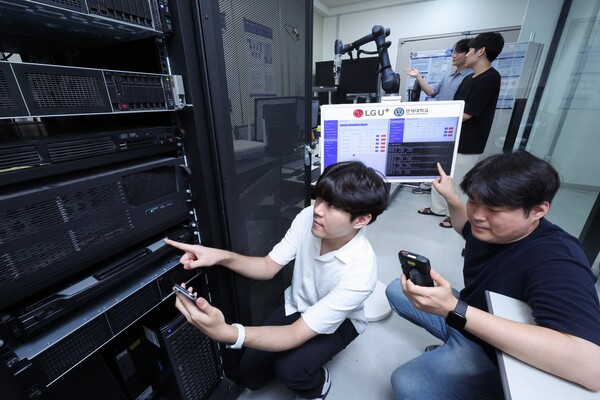
LG Uplus said on 19th it verified network switching technology between an AI-RAN trial network and a 5G network with Yonsei University.
AI-RAN is a next-generation wireless network technology in which AI analyses and optimises network conditions in real time. It can predict potential deterioration in communications quality in advance and use network resources efficiently, and is considered a key network technology for the 6G era.
As "physical AI" technology spreads, the importance is growing of technology that keeps connections stable even when moving between different networks while in transit.
The verification was conducted by linking LG Uplus' 5G network with an Nvidia GPU-based AI-RAN trial network developed in-house by Yonsei University.
It simulated situations in which physical AI equipment such as robots and drones moved from the AI-RAN trial network to the 5G network, or entered the AI-RAN trial network from the 5G network. Through this, it confirmed that terminals can automatically select the optimal network according to changes in the wireless environment and maintain stable connections. Point Mobile's PM95 terminal, from the industrial mobile device specialist, was used for the verification.
LG Uplus will move to foster a domestic AI-RAN ecosystem based on the demonstration. Together with Yonsei, it will provide an environment in which small and medium-sized companies in South Korea can directly test and verify AI-RAN-related technologies, and support them so the environment can be used as a testbed for overseas expansion.
Sang-heon Lee (이상헌), head of advanced NW development at LG Uplus, said, "The more physical AI technology advances, the more networks must evolve toward analysing the environment on their own and providing optimal quality." He said, "We will advance wireless network technology using AI and provide the stable connectivity and quality needed for future industrial services."
Seong-ryun Kim (김성륜), a professor in Yonsei University's School of Electrical and Electronic Engineering, said, "This verification is a meaningful industry-academia cooperation case in that it confirmed physical AI services can maintain connectivity even in the process of moving from an AI-RAN-based trial network to a commercial mobile communications network."
 Jin-ho Lee
jhlee26@d-today.co.kr
Jin-ho Lee
jhlee26@d-today.co.kr