
[DigitalToday intern reporter Seung-a Yoo] Korean retail investors are seen to have sharply increased purchases of U.S. stocks as the domestic market entered a correction phase.
On Aug. 17 (all times local), CNBC reported that Korean investors’ net purchases of U.S. stocks in July totaled about $4.5 billion, showing a clear flow of funds leaving the domestic market and moving into U.S. markets.
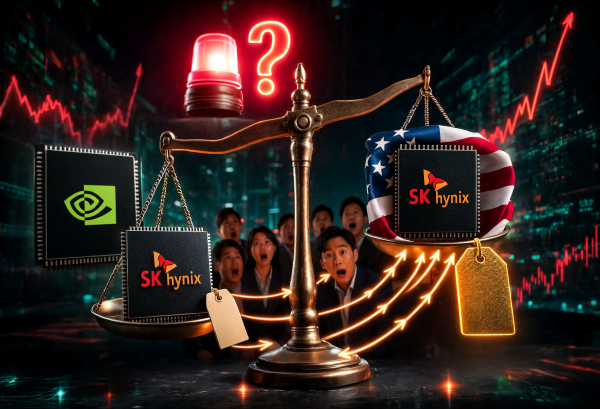
The money went not so much into completely new investments as into artificial intelligence (AI) semiconductors and high-risk products that investors had already favored. Of July net purchases of U.S. stocks, about $840 million went into SK Hynix American depositary receipts (ADRs), based on figures from the Korea Securities Depository. SK Hynix ADRs ranked second in Korean investors’ net purchases of U.S. securities. That meant investors bought the U.S.-listed shares even though they can directly buy the same company’s stock in the domestic market.
A price gap also emerged. Owen Lamont (오언 라몬트), senior vice president at Arcadian Asset Management, said SK Hynix ADRs recently "traded about 10 percent above the Korean shares." He called Korean investors’ buying of the SK Hynix ADR "completely abnormal" and said there is "no reason" for Korean investors to buy ADRs of Korean shares in the United States.
Lamont pointed out that such a price difference is rare and could be a sign of excessive speculation. He called it "a symptom of a bubble" and also mentioned that similar distortions occurred in Taiwanese and Indian companies during the dotcom boom.
An analysis also emerged that increased U.S. stock buying does not necessarily mean reduced risk appetite. Among the 10 most popular U.S. stocks among domestic investors this month, seventh place was the ProShares Ultra QQQ ETF, a leveraged product. Four of the top 10 net-bought names in July were also leveraged products. The most purchased product was the Direxion Daily Semiconductor Bull 3X Shares ETF, known as SOXL, which tracks three times the daily return of a semiconductor index. ProShares UltraPro QQQ and ProShares Ultra QQQ ranked fourth and sixth, respectively.
Phillip Wool (필립 울), head of research at Rayliant Global Advisors, said, "If you take a close look at what they are buying, most are linked to the same AI hardware theme that was sold in the domestic market." That means investors changed markets, but the underlying bets did not change much.
Yoon Jung-in, CEO of Fibonacci Asset Management, offered a similar assessment. He said some investors who suffered losses in Korean semiconductor stocks or leveraged ETFs may have moved into U.S. AI stocks expecting higher quality or liquidity. He added, "They may not be reducing exposure to the AI theme, but simply changing the geographic vehicle that expresses the same view."
In the domestic market, outflows of retail funds and a contraction in credit appeared at the same time. Data from the Korea Exchange showed retail investors were net sellers of domestic stocks for most of last week. Over the same period, foreign investors turned to net buying. Retail investors remained net sellers even though the country’s benchmark index entered a bull market range.
Margin loan balances also fell rapidly. According to the Korea Financial Investment Association, outstanding margin loans in the domestic market fell from about 37 trillion won at the end of June to 27 trillion won in early August, the lowest level this year. The domestic market had previously surged as retail money crowded into semiconductor stocks and leveraged products, then faced a sharp wave of selling and rebounded this month.
Many view the impact on the overall U.S. market as likely to be limited. Wool judged that while Korean retail investors have large influence in the domestic market, U.S. equities have a higher share of institutions and professional investors, so Korean inflows are not large compared with overall trading volumes.
Others also point out that volatility could rise in certain names or in areas favored by retail investors. Lamont cited a case in which Korean investors crowded into U.S. quantum computing-related stocks in late 2024, saying that growth in leveraged ETFs spreading across Korea, Hong Kong and the United States "could add volatility and amplify market moves." As a result, Korean funds moving to the United States may show effects first in specific themes and high-volatility products rather than in the overall market direction.
 Seung-a Yoo
ysah@d-today.co.kr
Seung-a Yoo
ysah@d-today.co.kr