
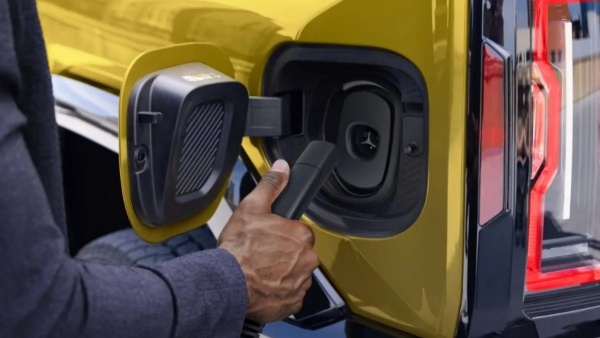
General Motors will equip its entire 2027-model-year electric vehicle lineup with the North American Charging Standard, or NACS, port as standard. New EVs from Chevrolet, Cadillac and GMC will be able to use compatible NACS fast chargers, including Tesla Superchargers, without a separate adapter.
Electrek, an electric vehicle outlet, reported on Aug. 14 that GM plans to apply the SAE J3400-spec NACS charging port as standard to EVs currently on sale or confirmed for 2027-model-year release.
Models covered include the Cadillac Escalade IQ and IQL, Lyriq, Optiq and Vistiq, as well as the Chevrolet Bolt EV, Blazer EV, Equinox EV and Silverado EV, and the GMC Hummer EV pickup and SUV and Sierra EV.
The shift to NACS has already begun. The 2026-model-year Cadillac Optiq has adopted the NACS port, and the new Chevrolet Bolt, to be released in 2026 as a 2027-model-year vehicle, will also adopt NACS as standard.
Most 2026-model-year GM EVs still use the CCS1 charging port. Except for the Optiq, the Blazer EV, Equinox EV, Silverado EV, Lyriq, Vistiq, Escalade IQ and IQL, Sierra EV and Hummer EV require a separate NACS DC adapter to use Tesla Superchargers.
GM sells its NACS DC adapter for $275. It can be used at NACS DC fast chargers, including more than 27,500 compatible Tesla Superchargers, but some Superchargers are still operated exclusively for Tesla vehicles.
By contrast, 2027-model-year GM EVs will need a CCS1 DC adapter to use existing CCS1 fast chargers. The price is $189. An adapter for using the existing J1772 standard, such as for home chargers, is also sold for $67. A package bundling the two products costs $256.
Charging station use will also be simplified. GM has applied an "Energy Pass" feature to the Chevrolet, Cadillac and GMC apps so registration and payment across multiple charging networks can be handled in one place. It currently supports Tesla Supercharger, Ionna, Electrify America and ChargePoint, and GM plans to add EVgo.
GM said the networks cover almost 70 percent of U.S. DC fast chargers. At compatible stations, "plug and charge" is also supported so the vehicle can authenticate automatically and pay charging costs in the background.
The shift is expected to broaden the range of charging stations GM EV users can choose from. Access to Tesla Superchargers, in particular, will improve significantly as NACS is adopted as standard.
Charging standards will not be unified into a single system in the short term. As existing CCS1 and J1772 infrastructure continues to operate, GM EV drivers are likely to need to keep multiple types of adapters on hand for the time being, depending on the situation.
 Jinju Hong
hongjj@d-today.co.kr
Jinju Hong
hongjj@d-today.co.kr