
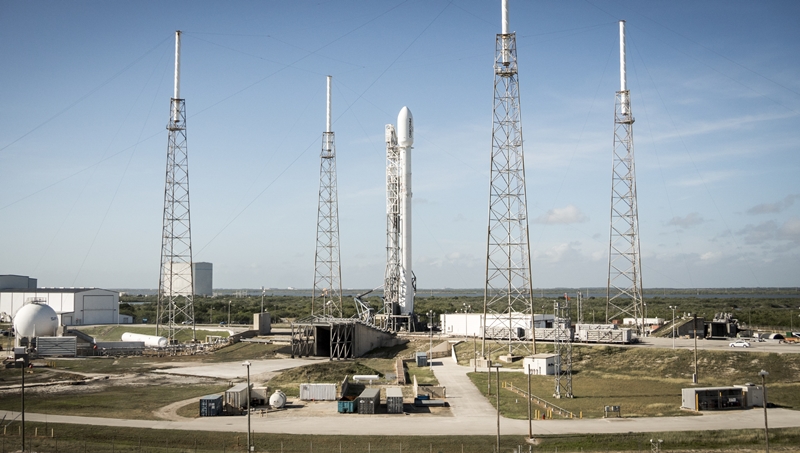
[Digital Today reporter Hyunwoo Choo] SpaceX’s Falcon 9 rocket has changed the cost structure and market share of the global launch vehicle market by combining reusability with a high launch frequency, an analysis said. It said Europe faces a policy dilemma over whether to back its own launchers or choose U.S. launch technology.
IT outlet Ars Technica reported on Aug. 14 that public policy researchers in Britain and Italy published a study in the journal Economics Letters analyzing launch data from more than 6,700 missions from 1960 to 2025.
The researchers said the introduction of the Falcon 9, its reusability and its high launch cadence have significantly reshaped the global launch vehicle market. SpaceX has increased Falcon 9 launches over the past five years from dozens to the hundreds, and now accounts for more than three-quarters of the total mass delivered to orbit. Much of the mass is Starlink satellites, but it is also launching payloads for rivals such as Amazon, Northrop Grumman, AST SpaceMobile and OneWeb because of cost competitiveness and a lack of alternatives.
Cumulative orbital payload mass by country has also shifted sharply. From 1990 to the early 2000s, the United States and the Soviet Union showed similar trends, but Russia began to pull ahead after the 2003 Columbia space shuttle accident. The trend changed again from the mid-2010s, and the United States moved far ahead in the early 2020s as Falcon 9 operations expanded. The United States’ cumulative orbital payload mass since 1990 now exceeds Russia’s by more than twofold.
The U.S. rebound was also clear in annual global payload mass share. The U.S. share fell from nearly 50 percent in 1995 to under 20 percent in 2012, but rose to more than 82 percent in 2024.
The cost gap has also widened. Estimates based on public data put the United States’ average cost of transporting payloads to orbit at $3,225 per kg. Japan was tallied at $5,287, China at $5,809, Russia at $6,682 and Europe at $9,897. Ten years ago, U.S. and European launch costs were similar, but Europe’s costs have now risen to about three times those of the United States for comparable payloads. The researchers cited large rockets, higher launch frequency and reusability as key factors in lowering costs. They pointed to a small-rocket-centered structure as a reason India’s per-kg cost is close to $15,000.
The researchers also said Europe’s options have narrowed. They said countries seeking to meet launch demand only with domestic launch vehicles could see costs rise and the expansion of space-based businesses such as satellite constellations slow. Europe must choose whether to continue relying for now on low-cost U.S. launch technology or expand its space strategy using domestic technology that is expensive and lacks scalability, they said.
In competition over reusable launch vehicles, the United States remains in the lead and Chinese companies are also pressing ahead with development of the same technology. By contrast, the European Space Agency’s small reusable technology demonstration program, Themis, was scheduled to conduct low-altitude hop tests by 2022 but has yet to take off.
 Hyunwoo Choo
cookinpapa@d-today.co.kr
Hyunwoo Choo
cookinpapa@d-today.co.kr