
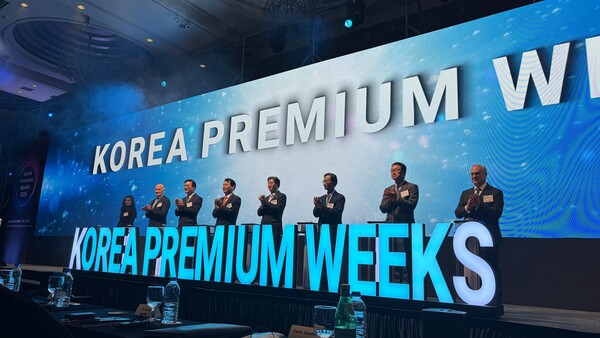
[DigitalToday reporter Sangyeop Oh] Figures from overseas investment firms and financial authorities gave a positive assessment of the growth potential of South Korean companies and capital market reforms. They said attracting more long-term investment money requires consistent enforcement of shareholder protection rules and improvements in foreigners’ trading convenience and market infrastructure.
At the opening ceremony of "Korea Premium Week 2026" held at The Grand Lotte Seoul in Jung-gu, Seoul, on Sept. 28, Joud Abdel Majeid (주드 압델 마지드), co-head of the BlackRock Global Partners Office, spoke highly of the competitiveness of South Korean companies in semiconductors, advanced manufacturing, energy and the defense industry.
He said South Korea’s capital market can supply the funding those companies need for their next stage of growth and connect them with global investors.
Abdel Majeid said investors need to believe the market is fair and transparent and that corporate governance is sound before committing money for the long term.
He gave a positive assessment of steps such as a corporate value-up programme, revisions to the Commercial Act and measures to improve market access for foreign investors. He also said consistent implementation and predictability of policy determine long-term investors’ trust.
Kevin Sneader (케빈 스니더), Goldman Sachs’ Asia Pacific head excluding Japan, also offered a positive long-term outlook for South Korea’s capital market. He cited improving corporate performance and stronger links with overseas capital markets as drivers, and said the next tasks are expanding market access and ensuring operational stability of the settlement and clearing system.
Sneader said reforms to the foreign exchange market and improvements to the structure of the stock market can lower entry barriers for overseas investors. He also stressed that shifting the stock settlement cycle to 1 business day after the trade date from 2 business days requires adjustments to related systems and market participants’ operational procedures.
Ito Yutaka (이토 유타카), commissioner of Japan’s Financial Services Agency, expressed interest in South Korea’s efforts to improve corporate governance, market infrastructure and reform the foreign exchange market.
He said South Korea and Japan share common challenges such as demographic change and sustainable growth, and that supervisory authorities and market participants in both countries need to share policy experience. He also stressed the need to advance financial innovation and bolster investor trust at the same time.
Jean-Paul Servais (장 폴 세르베), chair of the board of the International Organization of Securities Commissions (IOSCO), referred in congratulatory remarks to improvements in governance and investor protection in South Korea and to reforms of trading and settlement infrastructure.
He said cooperation among supervisors and international standards are important to respond to cross-border changes such as the spread of digital assets and artificial intelligence. He also stressed data that can identify market risks and consistency in regulation.
Ken Fisher (켄 피셔), founder and chairman of Fisher Investments, pointed to revisions to the Commercial Act that clarify directors’ fiduciary duty to shareholders and expanded English-language disclosures as notable changes.
Easier access to information in English also broadens opportunities for overseas investors to review South Korean companies, he said. He added that capital market improvement is not a one-off measure but an ongoing process.
 Sangyeop Oh
yub@d-today.co.kr
Sangyeop Oh
yub@d-today.co.kr