
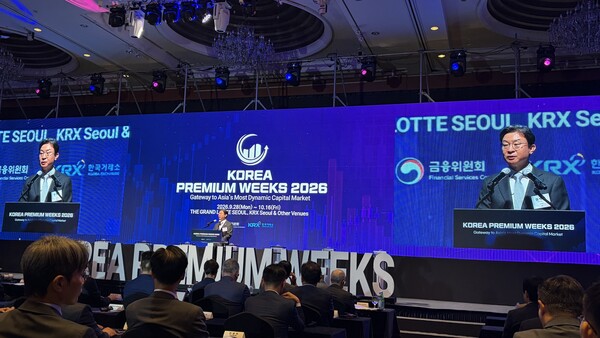
Korea Premium Week 2026, an event to promote South Korea's capital market to overseas investors, opened. The government presented directions for capital market reform, including expanding long-term investment and overhauling the Kosdaq market.
In an opening speech at Korea Premium Week, which opened on Sept. 28 at The Grand Lotte Seoul in Jung-gu, Seoul, President Lee Jae-myung (이재명) said, "The government has pursued system improvements such as revising the Commercial Act and strengthening crackdowns on unfair trading to resolve the Korea discount." He added, "We will do our best to create a transparent and fair market environment so that South Korea can leap to become the most attractive capital market in Asia."
Financial Services Commission Chairman Lee Eok-won (이억원) gave a positive assessment of companies increasing dividends and expanding treasury share cancellations. He said strengthening the foundation for long-term investment and investor trust is needed to sustain the capital market's growth. He also cited rising international oil prices, global pressure for higher interest rates, and uncertainty in the AI semiconductor cycle as variables for the stock market.
Byeon Je-ho (변제호), director general of the Financial Services Commission's Capital Markets Bureau, presented four policy directions: expanding the foundation for long-term investment, managing market risks, spreading shareholder-friendly governance structures, and reorganising the Kosdaq market. The plan is to continue existing reforms while also addressing vulnerabilities that surfaced amid the recent increase in stock market volatility.
To encourage long-term investment, the government will launch a "Child Self-Reliance Fund" in the second half of 2027. It will also push to introduce a "productive finance" individual savings account (ISA) that invests in domestic stocks and exchange-traded funds (ETFs) by the end of the same year. The total contribution limit for the productive finance ISA was set at 200 million won, higher than the 100 million won cap for existing ISAs.
The plan also includes allowing people to subscribe in addition to existing ISAs and expanding tax benefits. For foreign investors' omnibus accounts, the government plans to add ETFs and exchange-traded notes (ETNs), excluding leveraged and inverse products, to eligible investment targets.
In market risk management, it will implement supplementary measures such as order quantity units for single-stock leveraged products. It will also strengthen oversight of securities firms' credit extension limits by stock and of margin trading by minors.
The government plans to increase staffing for a joint response team against stock price manipulation to 100 from 90 and operate it as a permanent organisation. Granting the team the right to access communications data requires an amendment to the Capital Markets Act.
To protect shareholders, it will push from November to disclose and flag a list of companies whose price-to-book ratio (PBR) ranks in the bottom group for six consecutive half-year periods, by sector.
The benchmark will be the bottom 25 percent for KOSPI and the bottom 10 percent for Kosdaq. Companies that disclose comprehensive plans to raise corporate value will be excluded. The government will also review introducing interim dividends and requiring the board of the target company to disclose its opinion and grounds when a tender offer is made.
For Kosdaq, the government will broaden listing channels for promising technology companies while tightening delisting standards for distressed firms. In the second half of 2027, it will push a plan to split Kosdaq into "Select" and "General" tiers and introduce a promotion and demotion system.
The Financial Services Commission also presented plans to set up a specialised asset manager that will invest up to 10 trillion won over five years in core technology sectors and to create a Kosdaq-only fund worth 150 billion won.
Korea Exchange Chairman Jeong Eun-bo (정은보) outlined plans to improve trading infrastructure. Jeong said the exchange will gradually expand trading hours based on the Korea Exchange after-market opened this month, moving toward a 24-hour trading system. He said it will also pursue shortening the stock market settlement cycle together with exchanges in Asia.
Jeong also said the exchange will cooperate with relevant institutions and the financial investment industry in response to the spread of digital assets and build and operate a token securities platform. It plans to use AI for disclosure and market surveillance tasks.
Ruling Democratic Party lawmaker Yoo Dong-soo (유동수), chairman of the National Assembly's Political Affairs Committee, stressed legislation to raise investor trust. Yoo said he would accelerate the introduction of a mandatory tender offer system to protect minority shareholders and legislation related to digital assets.
 Oh Sang-yeop
yub@d-today.co.kr
Oh Sang-yeop
yub@d-today.co.kr