
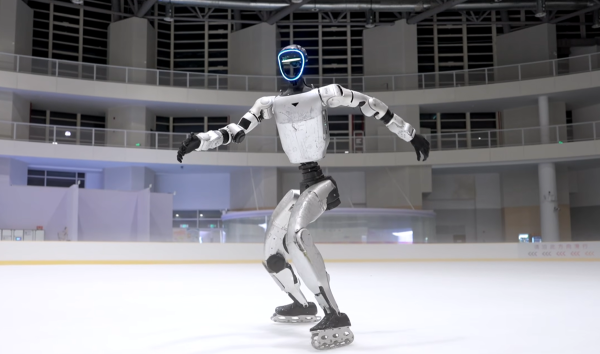
[Digital Today reporter Jinju Hong (홍진주)] China’s humanoid robot maker Unitree has succeeded in a record-breaking initial public offering (IPO). But market attention is focusing less on flashy robot demonstrations or listing fever than on whether it can make money at real industrial sites.
On Aug. 14 (local time), CNBC reported that Unitree set its IPO price at 150.8 yuan per share, raising about $900 million. Its valuation was put at about 61 billion yuan (about 12.8 trillion won). Unitree plans to list later this month on the Shanghai Stock Exchange’s STAR Market, a board dedicated to technology companies, becoming the first humanoid robot company to list on mainland Chinese exchanges.
The offering drew strong demand. Online subscriptions exceeded 5,000 times the shares on offer, and the allocation probability for retail investors fell to 0.018 percent. AI startup DeepSeek also took part as a strategic investor.
The issue is what comes after listing. Unitree’s robots have drawn public attention for kung fu moves and getting up after a fall, but assessments say they are still far from being usable repeatedly in industry and households. Hao Hong, co-chief executive at Lotus Asset Management, described humanoid robots as an interesting technology but pointed out, "I have not seen them actually doing housework."
Unitree also acknowledged in its securities filing that large-scale commercialisation could take longer than expected. It said in particular that the precision and durability of robot hands had not yet reached a level that meets sustained commercial use. Dominique Prost, an analyst at VP Bank, also said the tasks that current high-end humanoids can perform are limited and their operating time before battery recharging is not long.
Even so, money is flowing quickly into China’s robot market. Pre-listing perpetual futures linked to Unitree traded on Hyperliquid on Aug. 14 at about 4 times the IPO price.
One driver of growth in China’s humanoid industry is price competitiveness. Wood Mackenzie estimated that the average price of humanoids fell 93 percent in 2020 to 2025 to about $58,000. Unitree’s flagship G1 model sells for about $16,000.
Market forecasts are also optimistic. Wood Mackenzie projected that global deployments of humanoid robots will rise by more than 90 percent a year on average through 2035 to exceed 10 million units. China accounted for about 90 percent of global humanoid robot deployments last year, according to compiled figures.
But Unitree’s performance still shows a gap between expectations and reality. Revenue rose more than fourfold last year, but adjusted profit in the first quarter fell more than 52 percent as research and development and marketing costs increased. About three-quarters of humanoid revenue in January to September 2025 also came from research and education.
A $9 billion valuation is also a burden. Jeff Ko, chief analyst at CoinEx, viewed positively that Unitree is showing real revenue growth, but said a valuation of more than 200 times last year’s profit reflects considerable speculative expectations.
Technology friction with the United States is another variable. As the United States tightens regulations on foreign-made humanoids and quadruped robots, it could also weigh on Unitree’s overseas business. With about 13 percent of Unitree’s revenue last year coming from the United States, the impact of export controls is hard to ignore.
In the end, Unitree’s real test is not somersaults. The key is how much work robots can do in place of people at actual factories and logistics sites, and how much economic value they can create for companies in the process. Assessments say that beyond flashy technology demonstrations and an IPO boom, Unitree must now prove whether robots can really make money.
 Jinju Hong
hongjj@d-today.co.kr
Jinju Hong
hongjj@d-today.co.kr