
[DigitalToday reporter Sang-yeop Oh] The KOSPI and Kosdaq ended the week higher after rising in all 5 sessions this week. Foreigners bought more than 6.5 trillion won worth of shares this week, while individuals sold more than 7 trillion won, showing a clear split in flows.
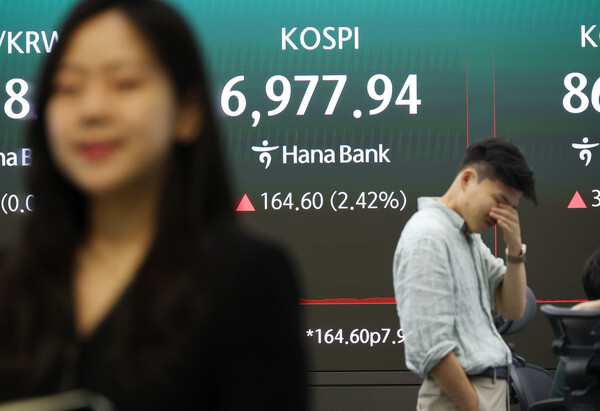
On Aug. 14, the KOSPI closed up 164.60 points, or 2.42 percent, at 6,977.94. The index opened up 182.33 points, or 2.68 percent, at 6,995.67. It rose to as high as 7,010.86, crossing 7,000, before giving up part of its gains and finishing in the 6,970 range.
In the main board market, foreigners led the rise as net buyers of 3.04 trillion won. Institutions were net sellers of 1.03 trillion won and individuals sold a net 1.98 trillion won.
Foreign buying supported South Korean stocks throughout the week. Foreigners were net buyers of a total 6.55 trillion won on the main board this week. In contrast, individuals were net sellers of 7.08 trillion won over the same period, appearing to take profits in the rising market.
The KOSPI and Kosdaq both closed higher in all 5 sessions from Monday to Friday this week. Inflows of foreign funds, led by semiconductor heavyweights, and sector rotation into mid- and small-cap shares and non-semiconductor sectors kept the broader market advancing.
Most of the top market-cap stocks also strengthened on the day. Samsung Electronics closed up 2.43 percent at 274,500 won, while SK Hynix gained 3.26 percent to 1,645,000 won.
SK Square rose 3.31 percent to 1,154,000 won, and Samsung Electro-Mechanics gained 3.66 percent to 1,558,000 won.
Hyundai Motor jumped 8.24 percent to 453,000 won. LG Energy Solution rose 1.09 percent, Samsung Life gained 3.26 percent and Samsung C&T added 1.10 percent. Samsung Biologics fell 1.02 percent.
The Kosdaq extended its rise. It closed up 3.28 points, or 0.38 percent, at 864.65. After rising early, it briefly turned lower, but rebounded in the afternoon to end the session higher.
In the Seoul foreign exchange market, the won-dollar exchange rate was 1,419.20 won, down 1.00 won from the previous session.
Through the previous day, stable U.S. inflation data, easing worries about rate hikes and expectations for the semiconductor industry supported investor sentiment in the domestic stock market. With foreigners' net buying expanding, support for stock-market flows has continued even as inflows of individual funds have recently slowed.
 Sang-yeop Oh
yub@d-today.co.kr
Sang-yeop Oh
yub@d-today.co.kr