
As the shipment gap in Europe’s battery market widens between South Korea’s top three makers and CATL, mandatory provisions of the EU Battery Regulation (EUBR) are entering an implementation phase. Starting with label requirements, the list expands in sequence to carbon footprint performance grades, supply-chain due diligence, technical documents for recycled content and battery passports. Compliance burdens are extending beyond cell makers to materials and parts suppliers that generate the values shown on labels.
According to industry on Aug. 14, under the EUBR, companies exporting batteries to the EU must display on labels the manufacturer’s information, manufacturing facility location, date of manufacture, weight, capacity, chemical characteristics and whether hazardous substances are included. The scheduled date for the obligation to attach a general battery information label and provide a QR code is Aug. 18. Critical raw materials included at 0.1 percent or more by weight must also be indicated.
The method of display is also standardised. According to law firm Shin & Kim, the recycling label must account for at least 3 percent of the largest surface area of the battery. For cylindrical cells, it must cover at least 1.5 percent of the surface area and comply with a maximum size of 5 by 5 cm. If cadmium is included at 0.002 percent or more or lead at 0.004 percent or more, the chemical symbol Cd or Pb must be attached separately. QR codes must be produced with sufficient colour contrast to be readable.
Regulations applied alongside labelling also apply. The scheduled date for the obligation to display carbon footprint performance grades for electric vehicle batteries is also the later of Aug. 18 or 18 months after subordinate legislation takes effect. The carbon footprint declaration, which underpins grade calculations, must present emissions across the full lifecycle from raw material procurement to manufacturing, transport, use and disposal and recycling as CO2-equivalent values per kWh.
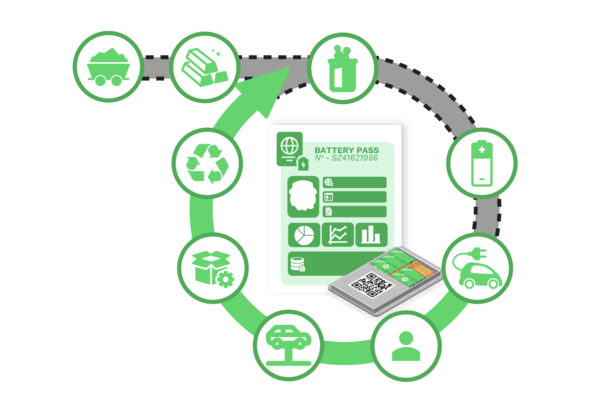
The EUBR plans to apply supply-chain due diligence obligations from Aug. 18, 2027 and, from Aug. 18, 2028, the obligation to prepare technical documents on recycled content in sequence. The battery passport system will be applied in earnest from 2027, and disclosures will include detailed composition information by material such as cathodes, anodes and electrolytes, part numbers by material, supplier contact information and the sequence for disassembling batteries.
◆EU battery rule compliance seen as factor shaping future market share
The ability to respond to regulation has become a variable that could again divide competition in Europe’s battery market. According to SNE Research, battery shipments in Europe totalled 234.9 GWh in 2025. CATL accounted for 102.2 GWh, while LG Energy Solution shipped 47.0 GWh, SK On 21.5 GWh and Samsung SDI 13.1 GWh, leaving the combined total for the South Korean three at 81.6 GWh. In 2022, the combined total of 61.3 GWh for the three exceeded CATL’s 46.1 GWh.
LG Energy Solution’s plant in Wroclaw, Poland and Samsung SDI’s plant in God, Hungary began construction in 2016, and SK On’s Komarom Plant 1 in Hungary began construction in 2017, accumulating nearly a decade of local investment in Europe. The Korea Institute for Industrial Economics and Trade analysed that future performance in the European market is likely to be largely determined by the level of response to the EU battery law.
The challenge is whether the three South Korean makers can build verification systems down to the supplier level. Materials and parts suppliers play an absolute role in securing the information needed to pass the European market. Values such as manufacturing facility location, hazardous substance content and the share of critical raw materials depend on data provided by first-, second- and third-tier materials and parts suppliers. Industry explains that even if cell makers have automated printing equipment, label credibility cannot be secured if input data are not verified.
In addition, supply-chain due diligence requires regular verification by a third-party verification body, and related documents must be kept for 10 years after the last battery is placed on the market. Verification results and reports must also be passed to downstream operators that receive the batteries, requiring document management systems at the supplier level as well.
Ultimately, the cost of redesigning verification systems reaches back to the raw material procurement stage. The Korea Institute for Industrial Economics and Trade cited the recycled material use obligation, the carbon footprint system and the battery passport system as regulations under the EU battery law expected to have large industrial ripple effects. An industry official said, "With K-battery market share in Europe having fallen below a majority, this is the time when a fast response is needed."
 Dae-gun Seok
d2dg@d-today.co.kr
Dae-gun Seok
d2dg@d-today.co.kr