
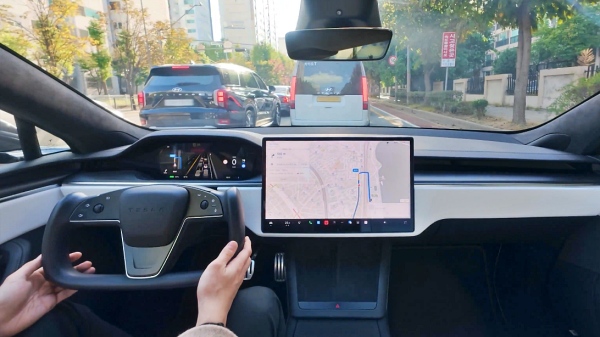
Tesla’s driver-assistance system Full Self-Driving (FSD) expansion has run into difficulties in China and Europe at the same time.
On Aug. 12, electric vehicle outlet CleanTechnica reported that tougher autonomous driving regulation and data controls in China, and controversy over non-disclosure of safety assessments in Europe, have emerged as key variables.
In China, there is speculation that it will not be easy for Tesla to advance to approval for a higher level of autonomous driving for FSD. China, like the United States, is taking a strict stance on managing vehicle and driving data collected by connected cars and autonomous vehicles. Tesla is a U.S. company, but earns about half of its revenue in China, and Elon Musk (일론 머스크), Tesla’s chief executive officer, has consistently made friendly remarks about the Chinese government and Chinese people. Even so, Tesla faces constraints that prevent it from sending data collected in China abroad, effectively to the United States.
Local analysts assessed Beijing’s likelihood of approving Tesla’s advanced autonomous driving functions as a “still distant prospect”. They also pointed out that although Tesla recently hired FSD test personnel in China, data regulation remains the key obstacle. Expectations are that demand for lobbying the government over this issue will continue for the time being.
The Chinese government recently released, for the first time, an outline of mandatory standards for autonomous driving systems. The standards are set to take effect from July 1, 2027, and are seen as stricter and more notable than existing approaches at the U.S. or U.N. level. For Tesla, this means that even if it pushes to expand in the Chinese market, it may need more time to adapt to regulation.
In Europe, non-disclosure of verification information has emerged as a bigger issue than the approval process. In some European countries, FSD is already being introduced within the approved scope, but whether it will be approved across the European Union is not yet confirmed. European regulators could make a bloc-wide approval decision as early as October.
The problem is that the Dutch regulator leading the review is not disclosing how it judged FSD’s safety. The Netherlands Vehicle Authority, RDW, cited protection of trade secrets as the reason for not releasing the details of its assessment. Emails that have been made public show indications that Tesla asked the RDW from 2024 to permanently keep safety review materials confidential.
In the emails, a Tesla official said the process could not proceed further until there was confirmation that certain documents would never be disclosed to the public. Regulators in other European countries, including Germany, Norway and Denmark, were also reported to be refusing to disclose related materials, and an agreement appears to have been reached on the premise of non-disclosure.
Opposition voices within Europe are also clear. France said it would not approve FSD. It cited concerns about speeding and said the technology is not sufficient to ensure that a human driver continues to pay attention.
The EU is set to put to a vote on Oct. 6 whether to approve bloc-wide use of FSD.
 Seung-a Yoo
ysah@d-today.co.kr
Seung-a Yoo
ysah@d-today.co.kr