
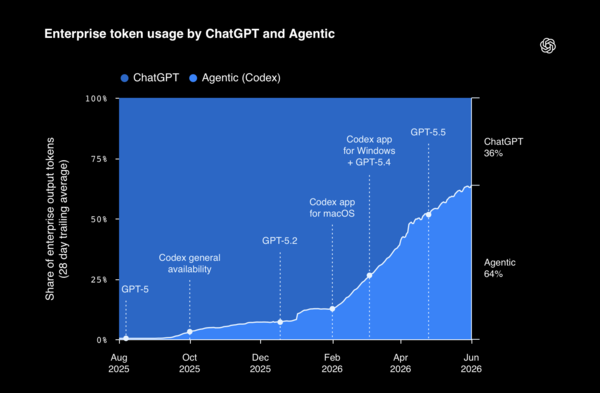
OpenAI enterprise customers generated 64 percent of their AI usage from Codex. Output tokens per user at frontier companies, the top 10 percent in AI use, were 8.3 times those of typical companies, widening the gap in corporate AI use.
On Aug. 13, OpenAI released an "Enterprise Signal" report with those findings.
OpenAI defined Codex tokens as an indicator of agentic AI use. While ChatGPT is mainly used to answer questions and develop ideas, agentic AI such as Codex uses computers and various tools to find information, edit files or directly carry out multi-step tasks.
OpenAI’s analysis said corporate AI use is shifting from "assistance" to "delegation," where work is handed over. It also said that assigning complex, long-running tasks to agents requires more computation and tokens, which contributed to the rise in Codex usage.
The gap is also widening quickly between companies that actively use AI and those that do not. OpenAI classified the top 10 percent of companies by output tokens per monthly active user as "frontier companies" and those in the 45th to 55th percentiles as "typical companies."
In June, output tokens per active user at frontier companies were 8.3 times those of typical companies. The gap widened to more than three times its January level of 2.6 times in five months.
By sector, the information and technology field had the biggest gap, with frontier companies using 11.7 times more tokens than typical companies. Manufacturing showed a 5.3 times difference. In contrast, the increase in AI usage among typical companies was limited to 1.9 to 2.8 times by sector.
Use of AI agents is also spreading quickly from developers to non-developer roles. Since February, weekly active Codex users within companies increased 108 times in legal functions. Sales and hiring rose 41 times each, and marketing grew 26 times. Over the same period, engineering increased five times.
OpenAI said software development adopted AI agents first, but the fastest recent growth in users is coming from general knowledge workers.
An analysis of more than 10 million enterprise messages found that about 75 percent of agentic AI messages involved coding and tasks related to system and agent operations. The share of system and agent operations messages was also high among non-developer roles, at 32 percent for hiring, 26 percent for sales, 25 percent for policy and 24 percent for communication.
Companies that actively use AI also differed in advanced feature usage. Plugins were used by 21 percent of weekly active users at frontier companies, more than twice the 9 percent at typical companies. Skills, which allow reuse of task instructions, were used by 19 percent at frontier companies versus 3 percent at typical companies, a gap of more than six times.
OpenAI said AI agents need access to corporate data, work context and external tools to carry out real tasks. Its analysis said the level of use depends not only on model performance but also on how much companies connect the work environment and tools to agents.
OpenAI said token usage is not an indicator that directly shows the value of corporate AI use. It said short answers can create high value and long answers do not necessarily mean greater value. It said it used token usage as a gauge of how deeply and complexly employees delegate work to AI.
The Enterprise Signal was based on anonymised and aggregated usage data from OpenAI’s global enterprise customers. The company said message content was classified by automated systems and OpenAI staff did not directly view customer messages.
 Seulgi Son
sageson@d-today.co.kr
Seulgi Son
sageson@d-today.co.kr