
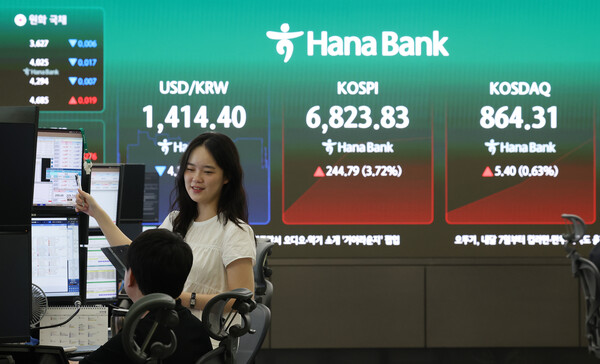
South Korea's KOSPI jumped more than 4 percent in early trade on strong buying by foreign and institutional investors, breaking above the 6,800 mark. As rate concerns eased after the release of U.S. inflation data, large semiconductor stocks such as Samsung Electronics and SK Hynix are again showing strong gains.
According to the Korea Exchange on the 13th, the KOSPI was up 291.45 points, or 4.43 percent, at 6,870.49 as of 9:18 a.m. It opened up 194.88 points, or 2.96 percent, at 6,773.92 and climbed as high as 6,895.63, nearing 6,900.
In the main bourse, foreigners and institutions were net buyers of 460.4 billion won and 294.6 billion won, respectively, driving the index higher. Retail investors were net sellers of 759.0 billion won.
Gains in major semiconductor stocks stood out. Samsung Electronics was up 5.28 percent at 269,000 won, while SK Hynix rose 7.98 percent to 1,624,000 won.
Semiconductor-related stock SK Square also surged 10.64 percent to 1,133,000 won. Samsung Electro-Mechanics rose 13.33 percent to 1,513,000 won, posting a double-digit gain.
Elsewhere, Hyundai Motor was up 3.66 percent at 424,500 won, and LG Energy Solution rose 0.84 percent to 361,500 won. Samsung Life Insurance and Samsung C&T were up 4.13 percent and 5.87 percent, respectively. Samsung Biologics fell 1.16 percent.
The KOSDAQ moved in a different direction from the KOSPI. At the same time, the KOSDAQ was down 3.54 points, or 0.41 percent, at 855.37.
In the Seoul foreign exchange market, the won was at 1,413.20 per dollar, up 5.80 won from the previous session.
With some profit-taking emerging in the KOSDAQ and small and mid-cap stocks that had surged recently, demand appears to be shifting back to KOSPI large caps led by semiconductors.
Han Ji-young (한지영), an analyst at Kiwoom Securities, forecast that with the U.S. July consumer price index (CPI) matching expectations and easing the burden of rising rates, and with U.S. semiconductor stocks gaining, supportive factors would likely affect not only domestic semiconductors but also other sectors.
There is also an assessment that the burden from foreign investor flows is easing. An analysis says that as concerns about a September rate hike by the Federal Reserve have diminished after the U.S. July CPI, it could have a positive effect on conditions for foreign investor flows going forward.
 Sangyeop Oh
yub@d-today.co.kr
Sangyeop Oh
yub@d-today.co.kr