
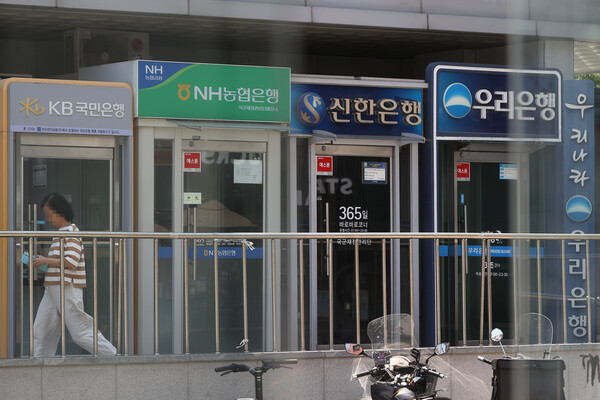
As stock market volatility rises, the flow of money is shifting. Funds that had been waiting for investment opportunities near the stock market fell below 100 trillion won, while more than 35 trillion won flowed into time deposits at the five largest banks in a month. After the policy rate hike, time-deposit rates at major banks also moved into the 3 percent range. With banks already holding ample funds, selective competition to lock in needed money is expected rather than a renewed rate war for deposits.
The Korea Financial Investment Association said investor deposits stood at 97.9289 trillion won as of Aug. 11, down 2.7890 trillion won from the previous day. It was the first time since Feb. 13 that investor deposits fell below 100 trillion won. Compared with the record high of 139.6947 trillion won on June 4, it was down 41.7658 trillion won, or 29.9 percent, in a little over two months. That means sidelines cash that swelled during a rising market has shrunk quickly after a recent correction.
When investor cash falls, time deposits rise by 35 trillion won
Bank time deposits are growing. Time-deposit balances at the five largest banks — KB Kookmin, Shinhan, Hana, Woori and NH NongHyup Bank — stood at 984.9399 trillion won at end-July, up 35.5401 trillion won from 949.3998 trillion won a month earlier. The increase widened sharply after rises of 7.5327 trillion won in May and 4.6837 trillion won in June.
Still, it is hard to say money leaving investor deposits moved straight into banks. The decline in investor deposits also includes funds used for actual stock purchases, and the rise in bank time deposits appears to include a significant amount of corporate money as well as household funds. Demand deposits fell by 56.4049 trillion won in July alone. Some analysis says corporate funds may also have moved back into time deposits after companies closed their books.
Even so, the simultaneous drop in stock-market sidelines cash and rise in time deposits shows that risk appetite has changed from early this year. The Bank of Korea last month raised the policy rate by 0.25 percentage point to 2.75 percent from 2.50 percent, lifting the appeal of deposits again. The central bank has said there is a need to maintain a tightening bias going forward.
One-year time-deposit rates at major banks have also moved into the 3 percent range.
As of Aug. 12, KB Kookmin Bank's KB Star Time Deposit offers up to 3.20 percent a year, and Shinhan Bank's Ssol Convenience Time Deposit also offers up to 3.20 percent a year for 12 months. Woori Bank's WON Plus Deposit also has a 12-month rate of 3.20 percent a year. At NH NongHyup Bank, NH All One e-Deposit is the highest at 3.25 percent a year.
For financial consumers, the ability to receive a fixed rate in the 3 percent range while protecting principal gives another option for money that is wary of stock market volatility.
Banking sector deposit competition likely to become a 'selective battle'
Whether deposit competition will turn into a rate-hike battle like in the past is unclear. The five largest banks' average loan-to-deposit ratio at the end of the second quarter was 94.9 percent, down 1.10 percentage points from the previous quarter. It was the first time since June 2023 that it fell below 95 percent. Given current funding conditions, it means banks have little incentive to raise deposit rates aggressively to secure funds.
As a result, deposit competition ahead is likely to differ from simply offering high rates to attract money. Raising deposit rates also increases the interest costs banks must bear. Banks have already been moving to secure time deposits by using high-rate special promotions and preferential-rate products.
With the possibility of further policy-rate hikes still on the table, it has become important for banks to secure time-based funding that they can manage stably for a certain period, as efficiently as possible.
From the customer’s perspective, the value of principal protection and fixed rates rises as stock market volatility increases. The view gaining weight is that rather than 35 trillion won moving directly from the stock market to banks, another portion of market money that had tilted toward stocks early this year has begun shifting back into deposits.
With stock-market sidelines cash falling below the 100 trillion won level and more than 35 trillion won piling into time deposits in a month, the direction of money is changing. Competition among banks is expected to shift toward securing stable funding.
A banking official said, "As stock market volatility increases, funds are flowing back into banks, but banks are not in a situation where they urgently need to secure deposits right now." The official added, "With time-deposit rates being adjusted in line with market interest-rate moves, consumers are likely to continue to pay attention for the time being to bank deposit and savings products, including special promotions that are being launched."
 Ji-young Lee
ljy@d-today.co.kr
Ji-young Lee
ljy@d-today.co.kr