
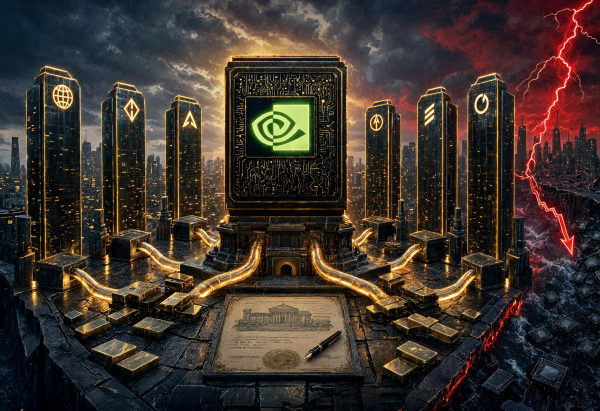
Nvidia is defining its artificial intelligence (AI) chips as long-term investment assets and pushing a $500 billion financing structure for data centres and graphics processing unit (GPU) clusters. But the structure is based on the assumption that GPU value holds up over time, and expanding supply of low-priced chips from China is seen as the biggest risk factor.
On Aug. 11, U.S. time, CNBC reported that Nvidia disclosed agreements it signed this week with six of the world's largest asset managers, including BlackRock, Blackstone, Apollo, KKR, Brookfield and Goldman Sachs. The idea is to build a $500 billion financing pipeline to fund construction of data centres and GPU clusters for companies that lack the cash or sufficient credit to buy millions of dollars' worth of semiconductors at once.
Nvidia Chief Executive Jensen Huang (젠슨 황) appeared on CNBC with top executives from the six firms and announced the plan. "Nvidia's AI factory platform is itself an investable asset and an infrastructure asset," Huang said. "It is productive, generates revenue, is substitutable, and nearly every cloud service provider uses it and it runs every AI model," he said.
The success or failure of the plan depends on one assumption. It assumes Nvidia GPUs retain value more like tangible assets such as commercial real estate or toll roads than like consumer electronics that quickly lose value.
In asset-backed lending, banks typically lend because if a borrower defaults they can seize and resell assets such as buildings, warehouses or cargo ships. Such tangible assets already have established second-hand markets and are often used for decades. By contrast, the economic lifespan of cutting-edge GPUs has not yet been clearly defined. New chips are used to train top-tier AI models, but after a few years they may be used for less profitable inference work, which could reduce resale prices and collateral value.
Ben Emons (벤 에먼스), founder of FedWatch Advisors, pointed to depreciation as the core risk in this financing structure. Emons designed similar asset-backed loans at IndyMac and later worked as a portfolio manager at Pimco. He said Nvidia chips could lose value faster than expected.
Emons in particular cited China as the biggest variable that could threaten this financing model. He said China could rapidly expand its domestic computing capacity and supply large volumes of low-priced semiconductors to the market to compete on price. If China-led supply expansion triggers a sharp drop in hardware prices, collateral supporting private loans worth hundreds of billions of dollars could fall in value before the loans mature, exposing investors to losses, he said. He estimated that investors would price GPUs not as real estate but as highly depreciating equipment, and would demand high returns of 11 to 17 percent depending on the risk in the capital structure.
Borrower creditworthiness is also a variable. BofA Securities said many companies using these funds are likely to be non-investment-grade firms that find it difficult to access traditional debt markets. AI startups and neocloud companies fall into that category. If they default, asset managers could end up having to resell recovered used chips into a market where prices are falling.
Still, the likelihood of China-related risks materialising immediately is not high. Huawei, which leads China's AI chip market, has been on the U.S. Commerce Department's restricted trade list since 2019. The U.S. government said in May that Huawei's Ascend AI chips violate U.S. export controls, and U.S. companies can no longer use the chips.
Nvidia's edge in the U.S. market also remains intact. Market estimates put Nvidia's share of the AI chip market above 75 percent. Supply and demand are also expected to favour Nvidia for the time being. Huang said that as hyperscalers race to expand, supply has tightened and H100 rental rates rose to about $2.35 per GPU hour this year from about $1.70 per GPU hour at the end of 2025.
Nvidia also offered software as part of its defence. It argues that its CUDA software layer, which helps developers run AI workloads on its GPUs, continues to lift hardware performance after deployment, meaning older chips can keep productivity and profitability longer than existing accounting models anticipate.
Ultimately, whether funding worth hundreds of billions of dollars for expanding AI infrastructure can be supplied steadily depends on how long GPUs hold their value. Whether Nvidia can have GPUs recognised as long-term investment assets rather than just semiconductors is the key variable in this financing model.
 Seung-a Yoo
ysah@d-today.co.kr
Seung-a Yoo
ysah@d-today.co.kr