
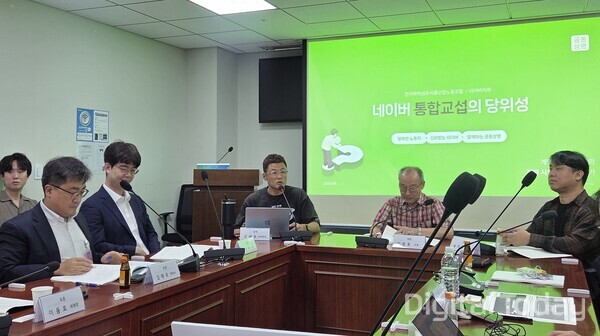
Naver's labor union is moving to pursue "group bargaining" that would handle wage and collective bargaining agreement talks, previously split between the parent company and each affiliate, under a single framework.
As a revised Trade Union and Labor Relations Adjustment Act that recently took effect has widened the scope for holding bargaining responsibility as an employer to entities that substantially control and determine working conditions, a central issue has emerged over how much influence Naver actually exerts over affiliates' working conditions.
The Korean Federation of Chemical, Textile and Food Industry Trade Unions and the office of Democratic Party lawmaker Lee Yong-woo held a forum on Aug. 12 morning at the National Assembly Members' Office Building on exploring group bargaining structures in the IT sector.
The forum addressed as a main issue a structure in which key decision-making authority in IT corporate groups is concentrated at the parent company while labor-management bargaining is conducted by each affiliate. The forum was arranged to review that structure and discuss whether it is legally and institutionally possible to bundle bargaining at the corporate group level.
The Naver union plans to hold a "group bargaining kickoff" event on Aug. 20, starting with the forum, to disclose joint bargaining agendas. It plans to demand that Naver begin group bargaining by the end of this month.
◆Affiliates separate, working conditions linked; need for group bargaining raised
Behind the push for group bargaining is a gap between Naver's affiliate operating structure and its current bargaining approach.
The Naver branch has organized not only workers at Naver's parent company but also affiliate workers into a single branch since its founding in 2018. According to the union, as of August this year about 6,200 people across 28 corporations, including Naver, are members, and 16 of those corporations have either signed collective bargaining agreements or are in talks. Wage negotiations and collective bargaining agreements, however, have so far been handled separately by each corporation.
In his presentation, Oh Se-yoon (오세윤), head of the Naver branch of the Korean Federation of Chemical, Textile and Food Industry Trade Unions, explained that about 150 bargaining sessions a year are held for 16 corporations and that about 100 labor and management bargaining committee members spend more than 1,000 hours a year on negotiations. The union's concern is that while the corporations are split, the substance of negotiations is broadly repeated in similar ways.
Oh cited as evidence cases such as an additional compensation system in 2021 being applied across affiliates at the same time, and a pattern in which affiliates repeatedly wrap up negotiations at similar times and levels after a wage deal is reached at Naver's parent company.
The union said Naver's decisions or standards affect affiliates broadly, from office buildings, work methods, welfare systems and internal systems to employee transfers between affiliates during a recent AI organisational reshuffle.
Based on that, the union is seeking a multi-layer bargaining structure in which issues decided in common across affiliates, such as wage funding, compensation systems and work systems, are handled in group bargaining with Naver participating, while special circumstances at individual affiliates are handled in separate bargaining as before.
◆Revised union law becomes trigger; scope of employer responsibility judged case by case
The direct trigger for this push for group bargaining is a revised union law that recently took effect.
The revised law broadened the scope for recognition as an "employer" under union law to include entities that are in a position to substantially and specifically control and determine a worker's working conditions, even if they are not a direct party to the labor contract. That provides a legal basis for a parent company to bear direct bargaining responsibility if it is recognized that the parent exercised substantial decision-making authority over a subsidiary's working conditions, even in a corporate group split into separate legal entities.
Kwon Oh-sung (권오성), a professor at Yonsei University Law School, who presented at the forum, cited the provision as a legal basis for group bargaining discussions. Kwon added, however, that employer responsibility for all working conditions across all affiliates is not automatically and comprehensively recognized simply because an entity is a parent company.
He said the extent of bargaining responsibility should be judged in line with the scope after examining how much control and decision-making authority the parent company actually exercises for each bargaining agenda item, such as wage funding, personnel matters, evaluations and compensation. That means that even if group bargaining takes place, it differs from a method of setting wages and working conditions uniformly for all affiliates. How to divide agendas handled jointly at the corporate group level and agendas that individual corporations can decide will likely be a key task in designing the bargaining structure going forward.
The discussion also addressed potential problems in operating such a structure. Kim Tae-wook (김태욱), a lawyer at the legal office of the Public Transport Workers' Union, raised the possibility that complexities could increase over choosing a union to represent bargaining, proving the parent company's employer status, and dispute procedures, in the process of dividing and negotiating agendas where the parent has substantial control and agendas where the subsidiary independently holds decision-making authority.
Park Myung-joon (박명준), a senior research fellow at the Korea Labor Institute, by contrast, viewed group bargaining as also having advantages for employers. He said it could reduce repeated bargaining and mediation procedures by corporation and allow principles to be established in advance that would apply across affiliates.
◆Naver Z wage dispute adds to focus; balancing management independence and fairness is key
As group bargaining discussions begin, labor-management conflict over wage negotiations is under way at some affiliates.
The union at Naver Z, the operator of metaverse platform Zepeto, recently secured the right to strike after a strike authorization vote passed with 98 percent in favor. Naver's parent company agreed to raise wages by 5.3 percent this year, while Naver Z's management proposed a freeze citing business conditions, and the union demanded an increase at the same level as the parent company. Whether and how an actual strike will take place has not yet been decided.
The case foreshadows future issues surrounding group bargaining. The union says working conditions commonly applied to affiliates should be negotiated together at the group level, but it remains a separate question how far to recognize management independence at individual corporations given that each affiliate differs in business stage, performance and financial conditions.
If group bargaining actually takes place, the key will be how far to recognize the scope of Naver's substantial decision-making authority over each affiliate's working conditions. Major variables will also include the criteria for distinguishing group-wide agendas from corporation-specific agendas, and how to balance each affiliate's management performance with fairness in compensation within the group. Ultimately, how the existing management structure centered on separate corporations and a group-level bargaining structure can coexist will be seen as determining whether group bargaining takes hold.
 Lee Ho-jung
lhj@d-today.co.kr
Lee Ho-jung
lhj@d-today.co.kr